 Published: 11 Jun 2026 | 8 min read
 Summarize in ChatGPT
I have a habit of pulling Resumeble data more often than is probably necessary. To be fair, most of the time, the patterns are pretty predictable, but occasionally, they can surprise you.
What our historical resume data says
This post started with my wanting to write an article about people in tech whose jobs are at risk of being replaced by AI.
I would guess that tech, with all the layoffs in the past few years, is the most affected. Earlier this week, I compared Resumeble's orders from January 1 to June 1, 2023, with the same period in 2026. Our order volume grew by about 88% between those two windows (yay, us!), which is in line with the business's overall growth, so nothing surprising there.
The most interesting data for me personally, though, was the industries where the orders were coming from.
In 2023, our top industries by volume were Information Technology, Hospital and Health Care, Marketing and Advertising, Human Resources, Financial Services, and Computer Software - a reasonable mix, one can argue, based on our core client persona and hiring/firing happening within the niches. In 2026, the list looks like this: Accounting, Information Technology, Hospital and Health Care, Computer Software, Sales, Financial Services.
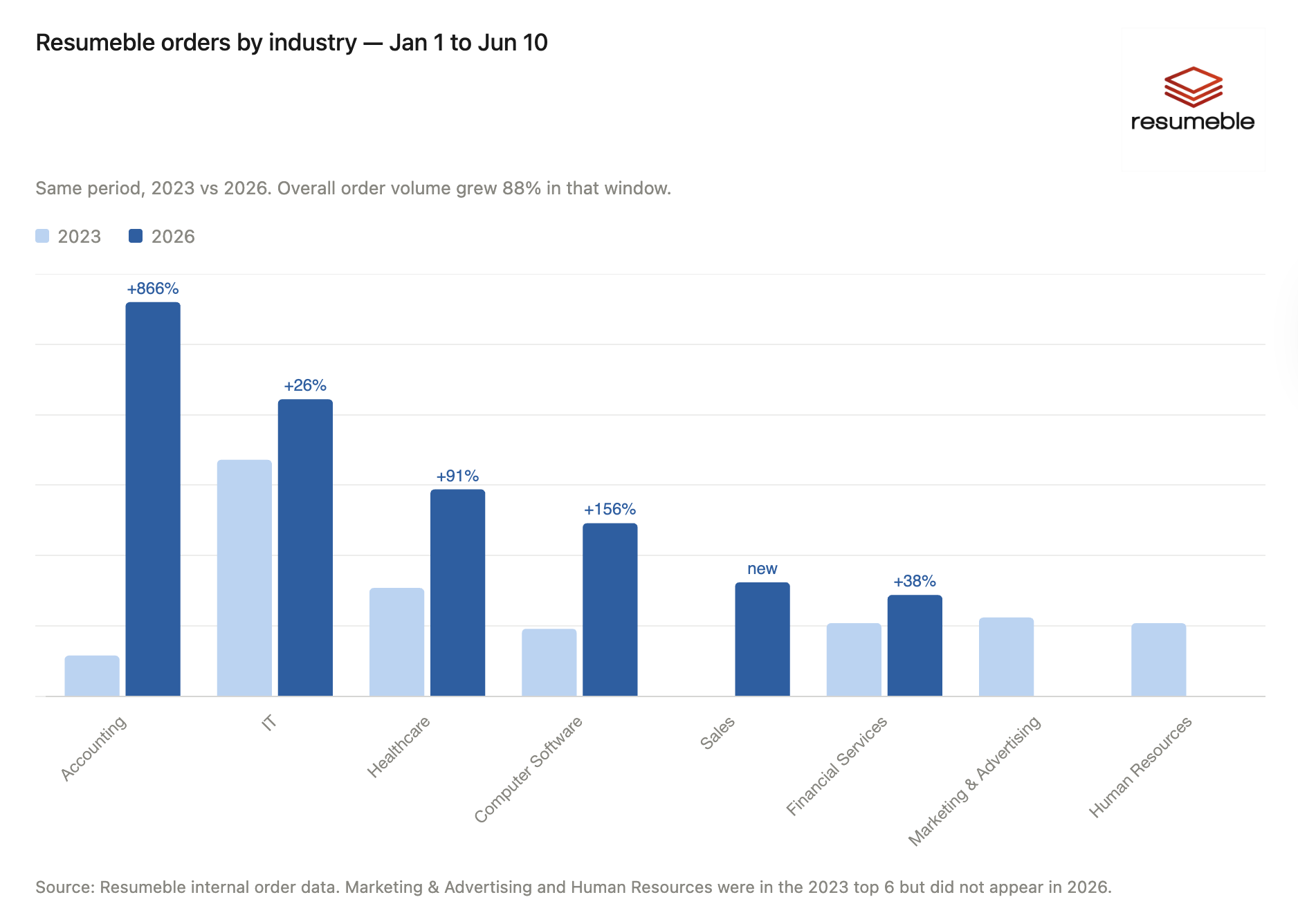
Two industries dropped out of the top six entirely, and two new ones took their place. One of them - accounting, which was barely a blip in our 2023 data, grew by a whopping 800%. If accounting had simply kept pace with our overall business growth, we would expect to see roughly double the 2023 orders. Instead, we saw nearly x10.
Who are our clients?
Order volume alone does not tell you why people are job searching. I want to be careful and specific - people update their resumes for many reasons unrelated to fear of being made redundant (promotion, relocation, long-overdue refresh, and many others).
Our questionnaires tell us a lot more than absolute numbers: junior to mid-level accounting specialists are either already laid off or worried they are about to be.
A manual review of roughly 50+ of those questionnaires and intake forms has also shown a troubling trend: for the most part, these are not people who pivoted into AI tools to stay ahead of the curve. They still list traditional accounting software, Excel, and general finance competencies in their resume skill sections. We even had a few who still wanted to include their typing speed as a skill.
I am not being dismissive or sarcastic here. I am saying this because this trend tells us something about how quickly the ground shifted beneath people. They were building their careers on a certain set of competencies, which were valuable a long time ago, and now they are left with a resume and a set of skills that no longer reflect a market that wants to hire them.
How AI tools affected accounting
Accounting is one of those fields in which automation has been on top of mind for years - ERP systems have long handled reconciliation and basic reporting. AI tools simply started moving up the value chain into tasks that used to require someone with 5+ years of experience in accounting. The entry-level work dried up first, which meant fewer entry roles; then the pipeline thinned out, leading mid-level professionals to suddenly compete for a smaller number of positions.
The people we are writing resumes for are not the CFOs. They are the staff accountants, bookkeepers, and AP clerks who built solid careers in roles that companies are now either eliminating entirely (or replacing with software subscriptions).
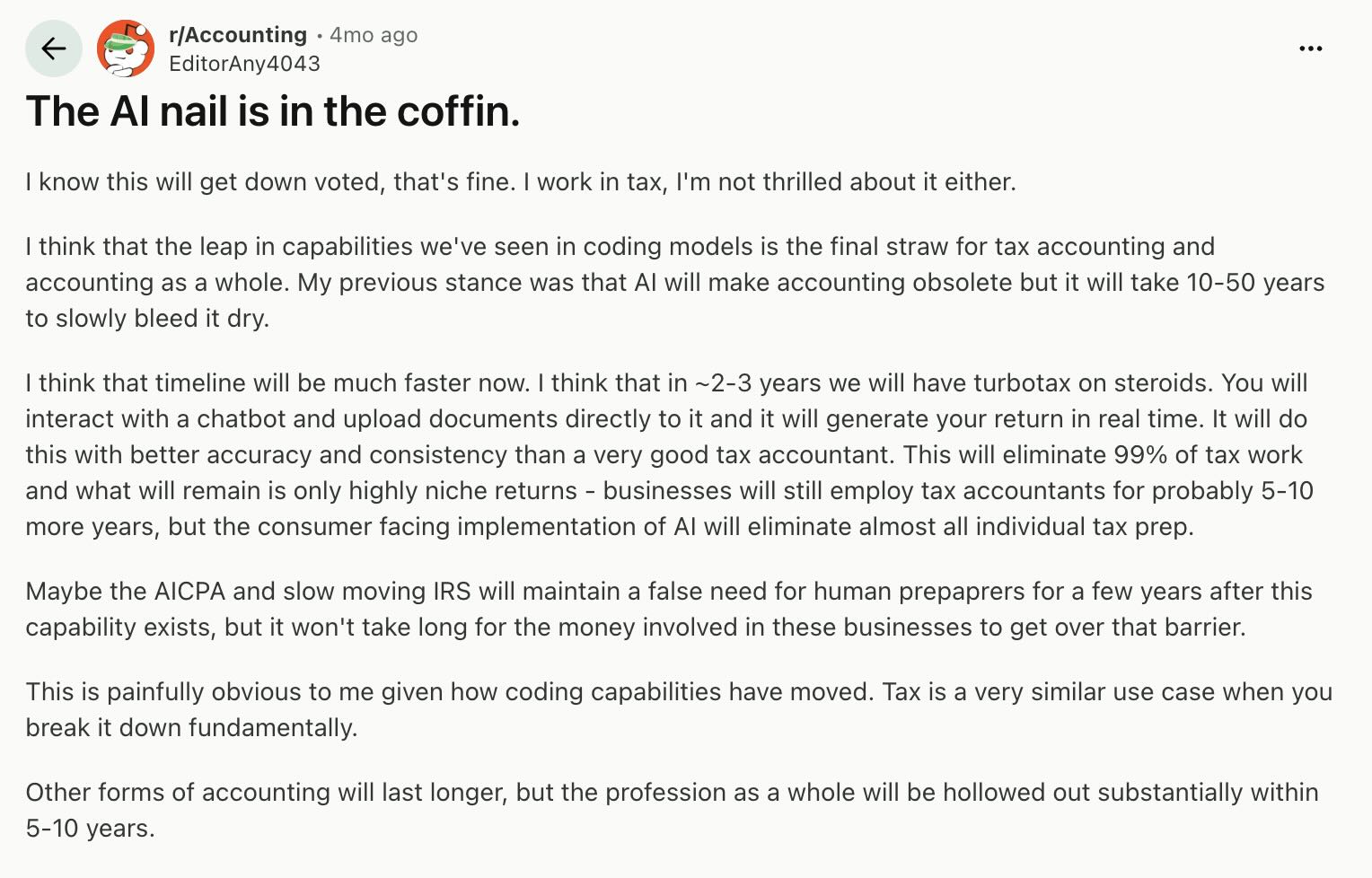
A post from r/Accounting, February 2026. The author works in tax.
And if there was any doubt about how seriously the technology industry views this opportunity, just a few days ago, Anthropic released 10 ready-to-run agent templates built specifically for financial services. The list of tasks these agents are designed to handle reads like a mid-level accountant's job description: closing the books at month-end, screening compliance files, generating reports. They are easy to deploy, readily available, and are being actively sold to companies that employ accountants.
The industries that are not worried (and why that is interesting)
Information Technology, Computer Software, Healthcare, and Financial Services all appear in both years. Their growth more or less tracked our overall business growth. Nothing alarming in either direction, which is especially good news for those who still see their future in Big Tech (despite all the alarming layoff news and green "Open to Work" banners we all keep seeing on LinkedIn).
But I found the more curious information in what DOES NOT appear in either year: science, biotech, pharma, and defense niches, to name a few, are consistently low among Resumeble's clients. These are fields where specialization runs deep, and the work is highly technical, heavily regulated, or both. AI is not totally irrelevant to these, but the disruption tends to fall on the admin and operational layers rather than on narrow specialists (despite what we keep hearing about generalists winning the game). A research scientist with a niche background is not losing sleep over ChatGPT or Claude the same way a junior accountant is.
At least, not yet...
Please don't read into AI being a universal threat to most white-collar jobs. It's moving through industries in a specific order, targeting the work that is most repeatable and most rule-based first. The careers at risk right now are not those doing intellectually complex work in their fields.
One thread across every industry
This might not be fully on topic, but it comes up so consistently that it is worth saying: when clients submit their existing resumes to their writers, soft skills are almost universally overrepresented. Someone, somewhere, has written that with all the AI automation, soft skills are front and center in hiring. And it might be true, but your resume is not the place to present them. Skills like team player, strong communicator, results-oriented, and so on, have no place on your resume or CV. People, for some reason, seem to believe that a resume can convey who they are as a person if they just use the right adjectives. It won't. A resume's job is to show what you did, where, and how well. Soft skills included in your Skills section or mentioned in the experience bullets without evidence are empty words that take up valuable real estate and irritate recruiters. If this is something you are doing, I would suggest that you stop.
What to do if your industry is on the wrong side of this data
The worst thing you can do right now is nothing. The second worst thing is frantic, unfocused activity that feeds your dopamine and makes you feel productive without making any difference (auto-applying to 200 jobs in a week, rewriting your resume 15 times, refreshing LinkedIn obsessively).
Instead of getting desperate, get intentional.
Here is a plan if you are looking for one

Tomorrow: Fix your resume BEFORE you need it, not the night after you get the layoff call from HR. If your skills section looks like it was written in 2019, that is the first thing to fix. AI tools are not going away, and the ability to work effectively with them is what separates candidates in fields being disrupted.
This week: Think seriously about your role and niche. What is the version of your experience that is most relevant to where the market is going? This is harder than it sounds, and for a lot of people, it is worth talking through with someone who can see it from the outside. Career coaching is not something that gets discussed enough in the context of AI disruption, but a good coach can help you identify transferable strengths you are probably underselling, map a realistic transition if you need one, and build a job search strategy that is actually specific to your situation rather than generic advice from an article. We offer career coaching at Resumeble if it is something you want to explore.
This month: Work on your LinkedIn, it matters even more today than it did two years ago. Recruiters are overwhelmed by AI-generated applications and are leaning more on professional networks and referrals. A weak or non-existent LinkedIn page is a missed opportunity.
* * *
The point I am trying to make is this: if you are in a field where the data points toward automation, you have to make a decision before someone else makes it for you. People who navigate transition periods with ease are not the ones who froze and waited to see what happens. Move deliberately and do not let someone else determine your timeline for you. I have been doing this for almost a decade. The clients who come to us with a plan, even a rough one, consistently do better than the ones who come to us in a panic. The accounting data tell me there are a lot of people right now who are somewhere between those two states. If that is you, now is a good time to move.