 Published: 28 May 2026 | 12 min read
 Summarize in ChatGPT
If you're one of the many job seekers experiencing a job search with little to no callbacks right now, you're not imagining it. As of 2026, ghosting rates have hit a three-year high, with 53% of job seekers reporting being ignored by employers after applying, up from 38% just two years ago, according to a Criteria report cited by Fortune. But the reason you're not getting responses may have nothing to do with your qualifications and everything to do with what your application looks like on the other end.
Why are so many qualified candidates getting ghosted right now?
Assuming you are qualified and are a good match to the roles you are applying for, the most realistic answer is this: recruiters can't tell you apart from fraudulent applicants, and the problem is far worse than most job seekers realize.
In 2026 hiring teams are dealing with an application fraud crisis on a scale that would have seemed unthinkable even a few years ago. All thanks to AI.
A talent acquisition leader at one tech firm analyzed her pipeline and found that 81% of incoming applications showed clear signs of fraud. Not "used AI to polish a cover letter" kind of 'fraud', but organized, systematic deception: identical resumes submitted under different names, newly created email addresses and phone numbers, LinkedIn profiles with no connections that disappear weeks after the application, and in some cases, real professionals' identities being stolen and impersonated wholesale.
One cybersecurity firm, Huntress, added fraud detection to its own recruiting stack and found that 23.2% of applicants over a three-month window were flagged as fraud risks. A separate Greenhouse study found that 91% of recruiters have spotted candidate deception in the past year, with 34% now spending up to half their working week just filtering out fake applications.
LinkedIn reportedly processes 11,000 job submissions per minute globally (that was in June 2025; 2026 might be even bigger!). At that volume, most teams have no choice but to use automated screening when hiring, and that screening casts a wide net.
Why fraud applications, you ask?
The motivations behind fraudulent job applications aren't random, and they're rarely just opportunistic. The most organized schemes involve remote workers (frequently operating from overseas) who get hired under a false identity and then quietly outsource the actual work to someone in a lower cost-of-living country, pocketing the salary difference. A software engineer role paying $180,000 in the US can be "performed" by a subcontractor in another country for a fraction of that, with the fraud hire skimming the gap.
Other schemes are more sinister: bad actors gain employment specifically to access company systems, client data, financial accounts, or proprietary code. In one well-documented 2024 case, a company called KnowBe4 unknowingly hired a North Korean operative who immediately began loading malware onto his company laptop.
Beyond these organized efforts, there is also a layer of pure resume fabrication. People who are not who they claim to be are applying for roles they cannot realistically do, running a con and gambling that they can fake the employment long enough to collect a few paychecks before anyone notices.
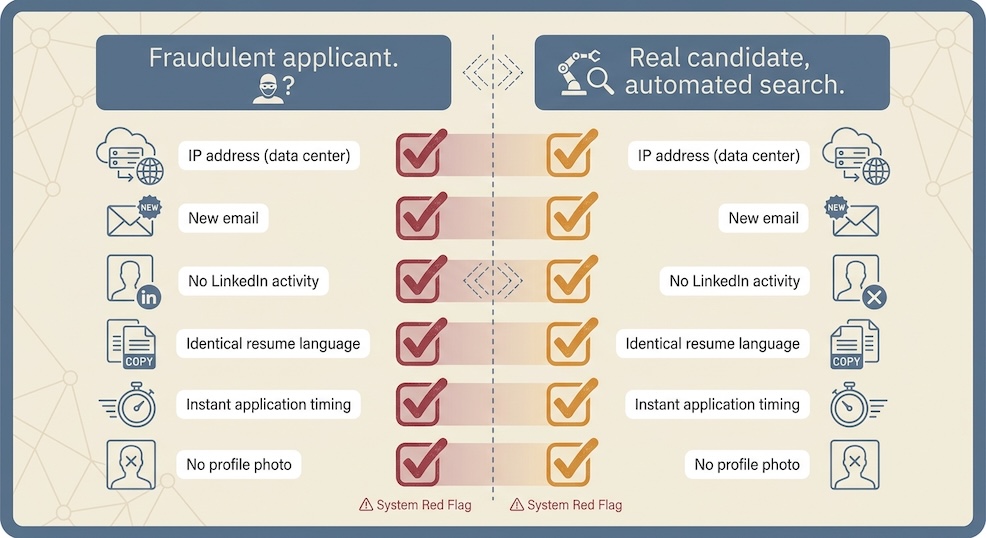
The problem is this, though: the signals that flag a fraudulent applicant look almost identical to the signals produced by a legitimate job seeker using common AI job search tools. And recruiters on LinkedIn have been talking about this for months now.
What does a "fraudulent" application actually look like to a recruiter?
Fraudulent applications in 2026 tend to share a specific pattern. Recruiters and detection systems are looking for:
- Applications submitted from data center IP addresses (not residential internet)
- Newly created email addresses with no account history
- A phone number that can't be tied to a long-term user
- A LinkedIn profile with no connections to the companies listed on the resume
- Resume language that is perfectly keyword-optimized but reads as generic
- Application timing that is inhumanly fast (mass-applied within seconds of a posting going live)
- No verifiable online presence to cross-reference against the application
Now consider what happens when a legitimate job seeker uses an AI auto-applier - tools that submit applications on your behalf, often via scripts, data center servers, and templated content. Your application may arrive looking like it ticked every fraud box on that list, even though you're a real person with genuine experience.
The result is that your resume gets deprioritized or even binned. This is one of the key reasons so many qualified candidates are experiencing no interviews despite strong backgrounds. A recruiter would rather risk losing on a few good candidates than facing a nightmare (and potentially risk their own job) that comes with hiring a fraudster. The hiring market is working, and people are getting hired every day. But your application might have been flagged as suspicious before anyone saw it, and to you, the job market feels like a Bermuda Triangle where resumes disappear into the void.
How does fraud detection work in hiring
Fraud detection layers that operate before a human review flag candidates based on the following signals:
Identity: Does the email address have a history? Does the phone number match a real long-term user? Is there a LinkedIn profile that's been active for more than a few weeks?
Behavior: Was this application submitted unusually fast? Did it come from an IP address associated with a data center or automation service? Did the same resume arrive under different names?
Content: Is the resume language statistically similar to hundreds of other applications that came in for this role? Does the content read as generated rather than written by a person?
Some systems might generate a "fraud likelihood" score and allow recruiters to sort or filter by it. The issue, as one recruiting consultant put it, is that this incentivizes bad behavior: recruiters working at speed will sometimes sort by "most likely real" and never reach the flagged batch, even when that batch contains genuine candidates.
A recruiter writing on Three Ears Media described it this way:
These systems are using AI to combat a surge in bot-submitted applications, but legitimate job seekers are being flagged as fake candidates for using old-school resume tactics.
This is the hidden trap of AI resume detection: the tools aren't sophisticated enough to distinguish "AI-generated by a fraudster" from "AI-polished by a real candidate using an auto-apply tool."
Are AI job appliers and resume tools making your job search worse?
For a lot of people, yes. Unfortunately.
AI auto-appliers promise efficiency. Submit to 200 roles while you sleep. Never write a cover letter by hand again. But the applications they send out often share the characteristics of fraud: same template, data center IP address, lightning-fast submission timing, no personalization. When one of those arrives in a recruiter's inbox alongside 400 identical fraudulent applications, it gets treated the same way.
There's a secondary problem, too. Over on r/jobs and r/jobsearchhacks, the frustration is palpable.
Threads are full of job seekers describing applying to 200, 300, even 500 roles with near-zero response rates. They are (understandably) defaulting to "the market is broken" as the explanation. In some cases, that's fair. But in many others, the lack of response is the system working exactly as designed: filtering out everything that looks like noise, and a mass-applied, AI-generated application looks exactly like noise.
If you have been applying to hundreds of jobs with no interviews, the question to ask is, "What does my application look like on the other end?"
What recruiters actually check to verify you're a real person
Recruiters at companies dealing with high fraud rates are increasingly cross-referencing applications against candidates' public online presence, specifically LinkedIn. What they're looking for:
- A complete profile with a photo. If someone shows up to a video interview and matches their LinkedIn photo, that's a basic but meaningful verification. It also deters impersonators, since bad actors are less likely to steal the identity of someone who is easily findable online with a face attached.
- Connections to the companies on your resume. If your resume says you spent three years at a company, but you have no connections, no interactions, and no mutual colleagues with anyone at that organization, a fraud-aware recruiter will notice. This doesn't mean you need 500 connections, but your employment history should be legible in your network.
- Account history and consistency. A profile created two weeks ago with 12 connections is a fraud signal. A profile with years of history, endorsements, and professional activity is not.
This matters for your job search strategy even if you've never heard of candidate fraud before. Recruiters are now doing a quick LinkedIn cross-check before deciding whether to move a candidate forward. If your profile doesn't hold up (or you don't have one), you may be losing opportunities.
What if you value your privacy and don't want a public LinkedIn?
That's a completely valid choice, but it comes with a real trade-off in the current market. By all means, guard your privacy, but go in with your eyes open.
If you have no public presence and you're applying through job boards using tools that generate automated-looking applications, you are stacking fraud signals on top of each other. The combination of "no verifiable identity online" plus "application that looks automated" is very difficult to recover from. A recruiter who might otherwise give you the benefit of the doubt has nothing to verify you against.
If privacy is important to you, or you are absolutely adamant about maintaining yet another social media account, the practical adjustment is to ensure your application signals authenticity in other ways:
- personalized cover letter
- application through the company's own website rather than a job board or LinkedIn
- some form of direct outreach or referral alongside the formal application.
That combination tells a different story than an auto-applied form submission with no digital trail.

Easy Apply: Is it actually helping you?
LinkedIn's Easy Apply button is convenient and lures you with a false sense of accomplishment, but it works against you in the current climate. When you 'Easy Apply', your application joins a pile that can number in the thousands for a single role, submitted through the same channel, often by the same automation tools, and screened by the same fraud filters that can't tell you from a bot.
How to fix a job search that's generating no callbacks
Treat it as a funnel problem, not a job market problem.
Step 1: Audit your application. Before sending another resume, ask yourself: Does this look like it was submitted by a human who genuinely wants this specific job? If you're using any automation tool, consider pausing it and manually applying to a smaller number of well-targeted roles instead. Test whether your response rate changes.
Step 2: Apply where your presence is verifiable. This means using the company's own careers page rather than a job board or LinkedIn. Job board applications add a layer of abstraction that makes it easier for fraud filters to misclassify you. A direct application to a company domain carries a different meaning.
Step 3: Update your LinkedIn TOGETHER with your resume. Make sure the two are consistent, that your profile is complete with a photo and job history, and that there's activity on your profile that reflects a real professional life.
Step 4: Write your own application materials, or get a human to do it for you.
This is the piece that feels like more work but pays off in a way automation can't replicate. A cover letter that sounds like a person (maybe a little imperfect, specific, direct about why this company and this role) does not read like fraud. It does not sound like everyone else's. And in a pipeline where a recruiter has learned to be deeply skeptical of polished perfection, a human voice stands out immediately.
A recruiter quoted in a recent Raconteur investigation on hiring fraud described the contrast: candidates who are continuing to submit real, human-written applications stand out both because they don't trigger detection systems and because they simply don't read like everyone else. In the current environment, that combination is a genuine competitive edge and something that many otherwise strong candidates are voluntarily giving up.
Is the job market actually that bad, or does your strategy need work?
Both things can be true, and pretending otherwise doesn't help anyone.
Yes, the market is more competitive than it was in 2021–2022. The overhiring of that era is still being corrected through layoffs, and companies in several sectors (looking at you, big tech!) have more options and are being more selective. The bar is legitimately higher.
But the data doesn't support the narrative that "no one is getting hired." Great people are getting hired every day. The problem for many job seekers who are experiencing a job search not working isn't the market itself. Their application strategy was designed for a different era, one that didn't involve fraud detection, identity verification, and automated scrutiny at every stage.
If you have applied to hundreds of roles and are getting no interviews, lack of progress is itself feedback. It might mean that your targeting is off or that your resume isn't clearing the first screen. But it might also mean you've inadvertently made yourself look like a bot. But do not worry, the fix for that is far simpler than a complete career overhaul.
The case for a human-written resume
There's an obvious irony in the fact that the same AI tools that promised to make job searching easier have made it meaningfully harder for many people. But there's a practical upside to knowing this: being human is now a differentiator.
A well-written, specific, authentic resume and cover letter doesn't just pass the fraud filter; it reads completely differently from the sea of identical AI-generated applications that recruiters are wading through. When 80%+ of a pipeline looks and sounds the same, the document that sounds like an actual person gets noticed.
At Resumeble, every resume and cover letter is written by an experienced professional writer - a human being who interviews you, understands your background, and writes copy that reflects how you actually think and talk. That means it doesn't trigger fraud alerts. It doesn't read like a template. And it doesn't sound like everyone else's.
If you're getting job application ghosting and aren't sure where the leak is, start with a free resume review - sometimes the issue becomes obvious immediately.