
Create a healthcare resume that stands out and be the ideal healthcare practitioner employers are seeking
The World Health Organization (WHO) projects a shortfall of 11 million healthcare workers, mostly in low- and lower-middle-income countries. That said, the healthcare industry will be more competitive in the coming years. It’s important to be intentional in presenting yourself as an ideal healthcare practitioner candidate.
The healthcare industry offers a variety of jobs, ranging from technical and administrative assistant roles to specialists. Jobs with less medical and technical input, such as medical transcriptionists and medical assistants, may be at the entry-level, but that should not end the story. Medical assistants trained by skilled doctors and specialists have valuable experience to show, and their knowledge must be reflected in their resumes.
Discover how to create a healthcare resume that showcases your skills and experience as a competitive healthcare professional. Check out Resumeble’s healthcare resume template writing guide below or find a free sample.
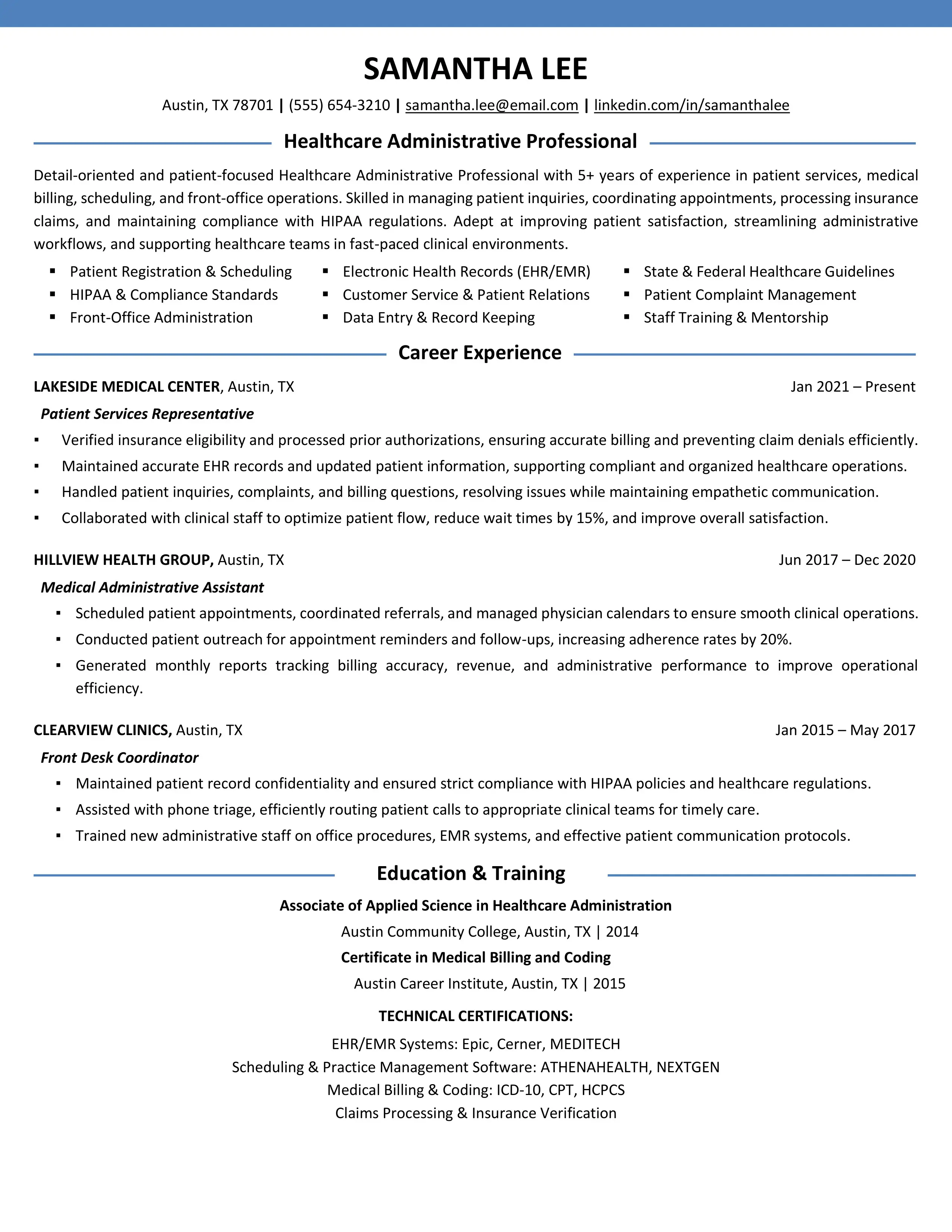





Creating your healthcare resume
Join millions of in-demand healthcare professionals. Create the best healthcare resume today!
What is a healthcare resume?
A healthcare resume provides relevant information about your career progression and goals as a healthcare professional or practitioner. It’s designed to present the skills and experience you’re most proud of to a prospective employer or healthcare institution. It covers any work or position you handled related to the medical or healthcare field.
Write a healthcare resume if you’re applying for the following titles and more:
- Athletic trainer
- Audiologist
- Cardiac sonographer
- Cardiovascular invasive specialist
- Cardiovascular perfusionist
- Central service technician
- Child life specialist
- Cytogenetic technologist
- Cytotechnologist
- Diagnostic medical sonographer
- Dietitian
- Echocardiographer
- Emergency medicine paramedic
- Genetic counselor
- Health information manager
- Hemodialysis technician
- Histology technician
- Hospital chaplain
- MRI technologist
- Medical scientist
- Medical massage therapist
- Medical physicist
- Medical social worker
- Medical speech-language pathologist
- Molecular genetics technologist
- Neurodiagnostic technologist
- Nuclear medicine technologist
- Nurse
- Nurse anesthetist
- Nurse midwife
- Nurse practitioner Occupational therapist
- Orthoptist
- Pathologists' assistant
- Perioperative nurse Pharmacist
- Pharmacy technician
- Phlebotomy technician
- Physical therapist
- Physician assistant
- Positron emission tomography technologist
- Radiation therapist
- Radiologic technologist
- Recreational therapist
- Respiratory therapist
- Diagnostic medical sonographer
- Surgical first assistant
- Surgical technologist
Learn more about how to make your resume stand out in the next section.
Create your healthcare resume
- Prepare all the information you need before writing your resume. This includes planning the best words to describe yourself and your experience. A regular resume structure contains the following sections:
- Contact information
- Career objective
- Relevant skills
- Work experience
- Educational background
- Training
- Certifications/licenses
- Choose the best resume format. The most common is the reverse-chronological format, which presents your career journey from the most recent to the oldest experience. If you have been working in healthcare for many years or have handled various roles for different companies, this format is the ideal way for your employer to see your progress. You may also use the functional format, which focuses on your specialties and unique skills, good for workers with employment gaps. A third format, the combination, which mixes both styles, works well for practitioners switching industries or specializations.
- Start writing your resume. Below, we provide a resume outline with a template structure to help you form a detailed, eye-catching resume.
Contact information
This section must be on top so that recruitment managers can easily reach out to you. This is your resume’s header. It includes:
- Full name – Use the name that appears on your professional or legal documents. Ideally, your professional profiles online should also show the same name. Some employers search online profiles with the name you provided, so consistency is important.
- Phone number – Provide the number of a phone you carry around at all times. Avoid adding a landline number that you can’t always answer. Set up a professional voicemail for when you’re unavailable and, if applying from aboard, use a standard international number format to avoid confusion.
- Email address – Provide a professional email address – and not the email you use in your current workplace! It would be best to have your name on the email, but if not, at least ensure that it sounds professional. Avoid casual-sounding addresses.
- Location – Write your city and state. Full addresses are unnecessary and can be a privacy risk. If you’re applying for a remote healthcare service role, you may add the country.
- LinkedIn profile – LinkedIn is a reliable reference for hiring managers. Add your LinkedIn to the resume to provide additional career details and skills that may not fit in your resume. LinkedIn also features recommendations and positive remarks from colleagues and previous supervisors, which employers may find useful and relevant.
Professional summary
Healthcare resumes start with a professional summary section that describes your professional background, skills, achievements, and goals in 2-3 sentences. This helps busy hiring managers gain insight into your qualifications at a glance in relation to the role. Emphasize your credentials, important achievements, and contributions to previous or current healthcare organizations. Quantify your accomplishments when you can. However, keep this section short, as it is meant to be a snippet of your work experience and skills. Leave the details to subsequent sections.
Career objective
This section is only for new healthcare workers starting in the industry or fresh graduates of healthcare schools and training facilities with very minimal experience. It consists of 2-4 sentences or bulleted phrases laying out your goals as a healthcare practitioner. This section is useful in informing prospective employers about your long-term plans and ways to succeed in the role. If you have ample experience and an extensive healthcare career journey, you can skip this section.
What to include in your healthcare career objective:
- Professional goals or what you want to achieve
- How your goals match the role you’re applying for
- Skills and training that support the role
- Strengths as a healthcare professional
Work experience
This section provides more detailed information regarding the aspects you presented in your professional summary. It includes your past jobs and work experience, professional development, and achievements related to the role. It must also include any form of paid medical residency, fellowship program, or clinical experience.
Present each job in this manner:
- Company/organization’s name and location
- Your job title
- Dates you worked at the company
- Duties and responsibilities in each title
- Relevant accomplishments
- Examples of success for each role
A few pro tips for writing your healthcare work experience:
- Use bullets for easy scanning. Some recruitment experts suggest 5 bullet points per job on a resume for the current job title and 3 bulleted duties for each previous role. However, this depends on how long you were in the job and the extent of relevant tasks assigned to you.
- Customize your work experience according to the role. Some previous jobs may not be directly related to your target role, even though they are healthcare positions. You may skip them for space and relevance reasons, or you can take the skills you developed from that job and place them in the skills section.
- Start each description with action words to make your resume sound lively. Use the present tense for a current job and the past tense for previous positions.
- Provide context on how you formed solutions for specific workplace problems.
- Quantify your accomplishments by using percentages, numbers, or measurable factors. For example, you can provide the number of patients you treated while working as a nurse or physical therapist.
Skills
This section is designed to distinguish other competencies you possess that are not anchored in your previous roles. It also showcases capabilities you developed over years of working in healthcare for multiple companies. These capabilities have become your strengths, giving you a unique advantage over other applicants in landing the role.
Skills are divided into hard and soft skills. The hard skills are skills you gain through education, training, and industry-specific experience, or through informal means such as non-formal training and pursuing technical hobbies or interests. The soft skills encompass a more general set of traits applicable to a wide range of jobs, not just healthcare. They are usually your interpersonal or organizational skills.
Hard skills
Here are examples of healthcare hard skills:
- Reading medical charts – This is one of the essential skills doctors and medical staff must learn to be able to diagnose illnesses as accurately as possible and provide the right treatment. Reading medical charts means understanding medical terminology and abbreviations to track the progress of patient care among medical professionals and staff. Various doctors and nurses treating a patient can identify problems that may arise and observe trends or patterns that will help them make quick treatment decisions.
- Familiarity with medical terminology – Medical terminology is the healthcare industry’s language. Learning it allows you to understand patient records and communicate with other healthcare staff in a language they recognize. Medical terminology is difficult to memorize, but it’s the key to better communication with your team and diagnosis.
- Diagnosing illnesses – Medical professionals must have the skill to identify illnesses or medical problems accurately so that they can recommend proper treatment. There are many ways and technologies healthcare practitioners use to diagnose medical conditions, such as physical examinations, scans, lab tests, and sonography. Being able to perform them or read their results is critical to a medical professional.
- Administering medication – Giving medication and the manner of doing so are also crucial skills that have a significant effect on a patient’s recovery. To be on point in administering medication, you must have a comprehensive understanding of the medicine, its dosage, frequency, and possible side effects. You must also know the right procedure for administering the medication, as a slight error could be dangerous to the patient.
- Performing surgery – This is one of the most difficult skills to learn, requiring years of study, training, and practice. That’s why surgeons are the most highly trained of the medical professionals, and also highly paid. Each surgeon's specialization, such as neurosurgery, cardiothoracic surgery, and orthopedic surgery, entails risks. Surgeons must be capable of assessing the situation and making fast decisions for the safety of the patient.
Soft skills
Here are examples of healthcare soft skills:
- Empathy – Perhaps the most downplayed soft skill, empathy is an important trait for healthcare workers. It helps you build better relationships with your patients by understanding their situation from their perspective. It helps you see their needs and communicate with them more effectively. This is why bedside manners are sometimes part of medical staff training; this is part of showing empathy.
- Communication – Miscommunication has no place in healthcare. An effective healthcare team must be able to talk to and listen to patients and each other efficiently. It includes focusing on what the other person is saying without getting distracted, understanding nonverbal cues and body language, and getting a good sense of how they are feeling. In healthcare, there might be times when you have to deliver difficult news to patients and their families. Knowing how to do it with respect and compassion is beneficial.
- Problem-solving skills – Healthcare practitioners regularly face circumstances where they have to come up with solutions quickly, to prevent fatal results or accommodate a patient’s urgent needs. Solving problems in time is a skill often learned or developed over years of handling various healthcare situations.
- Critical thinking – This goes hand in hand with problem-solving. Problem solvers must be critical thinkers, too. There are complex medical situations that may not be easy to solve. The ability to think through various options, weighing pros and cons, considering all the knowledge you’ve gained in med school and healthcare training, and making the best decision, is a big plus.
- Organizational skills – Strong organizational skills help doctors, nurses, and medical staff stay on top of their complex schedules. Being efficient in tracking patient information, supplies, procedures, and team assignments can make the healthcare workplace more efficient and in control. This helps improve patient care and frees up time for upskilling and continuous training.
- Teamwork – This is important for the success of patient care. To serve the patients’ medical needs well, the team must work together seamlessly with trust, respect, cooperation, and clear communication. Their efforts must be well coordinated to achieve a common objective for their patient. Employers appreciate a team player as much as an independent worker.
How to present your healthcare skills:
- Present a bulleted list
- Mention skills most relevant to the role
- Adjust the skills section for different job applications
- Use keywords mentioned in the job posting to make your resume recognizable to applicant tracking systems
- Make the skills section concise for easy scanning
- Avoid listing generic soft skills like “time management” or “teamwork”; show them through clinical experience instead
Education & Training
Your educational background provides further proof of your qualifications as a healthcare worker, adding to your credibility. Because of the technical skills required in healthcare, most practitioners have some form of formal education or training. The academic requirements for a healthcare career often depend on the field or subfield. Medical aides and assistants may only require a certificate or diploma, while doctors, nurses, and pharmacists require a degree.
In the same manner as the reverse-chronological work experience, start with your most recent educational activity and end with the oldest. For each entry, include the following:
- Name and location of the school or university
- Degree or diploma obtained, if applicable
- Field of study
- Date of graduation or completion (if you’re a recent graduate)
- GPA (optional). If it’s below 3.4, experts suggest skipping it
- Relevant academic achievements or honors obtained during education
What do employers look for in the education/training section?
Employers search for educational information that’s relevant to the job requirements. If you’re applying for an entry-level role, a hiring manager might look for a high school diploma or a college degree. In healthcare, many recruiters look for certifications or specific degrees essential to the role. Learn the educational requirements of the role by checking the “requirements” or “education” part of the job listing. If you know that the employer will consider credentials first before your professional experience, you can move the Education section higher, after your header and professional summary.
Certifications
You may add a separate section for certifications and licenses in your healthcare resume, as most healthcare jobs require them. This enhances your qualifications further. Here are examples of certifications required in the healthcare industry and their issuing bodies:
Medical Certifications
- Certified Coding Specialist Physician (CCS-P) - American Academy of Professional Coders
- Certified Patient Care Technician (CPCT) - National Healthcareer Association
- Certified EKG Technician (CET) - American Medical Certification Association and others
- Certified Phlebotomy Technician (CPT) - National Healthcareer Association and others
- Certified Clinical Medical Assistant (CCMA) - National Healthcareer Association and others
- Certified Medical Assistant (CMA) - American Association of Medical Assistants and others
- Certified Nursing Assistant (CNA) – The state where the nurse works or third-party agencies like the National Council of State Boards of Nursing
- Registered Behavior Technician (RBT) - Behavior Analyst Certification Board
- Certified Professional Coder (CPC) - American Academy of Professional Coders
- Certified Pharmacy Technician (CPhT) - Pharmacy Technician Certification Board and NHA
Healthcare Management Certifications
- Certified Professional in Healthcare Risk Management (CPHRM) - American Hospital Association
- Certification in Healthcare Quality Management (CHCQM) - American Board of Quality Assurance and Utilization Review Physicians
- Certified Medical Manager (CMM) - Professional Association of Healthcare Office Management
- Certified in Healthcare Compliance (CHC) - Healthcare Compliance Association's Compliance Certification Board
- Certified Professional in Healthcare Information and Management Systems (CPHIMS) - Healthcare Information and Management Systems Society
- Fellow of the American College of Healthcare Executives (FACHE) - American College of Healthcare Executives
- Certified Healthcare Financial Professional (CFHP) - Healthcare Financial Management Association
- Certified Professional in Healthcare Quality (CPHQ) - National Association for Healthcare Quality
Healthcare Professional Certifications
- Certified Professional in Patient Safety (CPPS) – Institute for Healthcare Improvement
- Certified Professional in Human Factors in Healthcare (CPHFH) - Institute for Healthcare Improvement
- Certified Professional in Age-Friendly Healthcare (CPAFH) - Institute for Healthcare Improvement
- Certified Professional in Clinical Health Equity (CPCHE) - Institute for Healthcare Improvement
In writing your certifications, include the name of your credential, the organization that awarded it, and the year you earned it.
Boost your career with a healthcare resume from Resumeble
Be one of the most in-demand healthcare professionals today. Choose one of our curated resume packages and let our writers create a winning healthcare resume for you!