 Published: 12 May 2026 | 10 min read
 Summarize in ChatGPT
Let's face it - most lawyers are excellent at constructing an argument and considerably less practiced at selling themselves. You don't get to change jobs often when you are a lawyer, and those are rarely found through a generalized job search. Most lawyers get recruited, go boutique, or find a job straight out of college. So once the need to write a CV arises, many find themselves staring at their 'out-of-college' old resume, wondering how to turn years of billable hours, case wins, and bar admissions into something that actually gets a viable job offer. This article is for those people.
I will try to walk you through exactly how to write a lawyer resume that works, with practical examples and advice that speaks to where the legal industry actually is right now.
What hiring partners are really looking for
Before we get into formatting and resume blocks, let's address the 'AI in the room'. Yes, every article I write about 'How to write a resume for [insert your niche here]' includes this chapter: AI in nursing, AI in teaching, etc. AI is indeed changing the job market at a pace that has probably not been seen since the invention of the steam engine. And lawyers and attorneys (especially the ones starting out who are looking to make a name for themselves) are very much not immune to it.

Mid-size and boutique firms are competing for top talent with significantly narrower mandates, while government and public-interest roles are badly underfunded and corporate in-house teams are consistently shrinking their outside spend. Everyone is deploying AI to build internal capacity instead.
What does that mean for your attorney resume? It means you need to lead with results. Credentials are great, but outcomes are the new king. Law school pedigree does open doors at a lot of firms, but it doesn't carry you through the whole interview process the way it once did. Partners want to see that you can handle matters independently and have touched real dollars or real cases.
Six sections every attorney's resume needs
1. Contact information & bar admissions
Don't bury your bar admissions below the first paragraph of your resume, put them at the top or directly beneath your name and contact details. A hiring manager in a New York firm scanning 200+ resumes won't dig for it. If you're admitted in multiple states or jurisdictions, list them clearly.
If your admission is pending, write "Admission pending, [State Bar], expected [month/year]".
2. Professional summary
The generic "results-driven attorney with X years of experience" opener stopped working post-COVID if it ever did. That sentence tells the reader nothing they don't already know or that hundreds of aspiring job seekers have not written before you. Instead, open with two to three sentences that name your practice area, your level, and your number one most defensible claim to competence.
Here is a good example:
That's specific, and that's what gets a second look.
3. Experience
This is the core of your legal resume, and also where most candidates go wrong. They list job titles and responsibilities (aka, things they were supposed to do) rather than what they actually did and what came of it.
For each role, list your most significant accomplishment(s) first. If you are under NDA, try to describe the nature of the work, the stakes, and the results as clearly as possible without naming the client.
Example:
- Managed discovery for a $40M commercial contract dispute; successfully opposed a motion to compel that would have required production of over 500,000 documents.
This is so much better than "Led discovery management".
Quantify where possible. Settlement values, case loads, deal sizes, team sizes you supervised, pro bono hours, favorable verdicts — all of these are fair game.
4. Education
For attorneys and other law professionals, education stays near the top of their resume longer than it does in other industries. List your law school, your J.D. year, and any distinction (law review, moot court, Order of the Coif, class rank if it's worth mentioning). If you have a relevant undergraduate degree or a dual degree (J.D./MBA, J.D./LLM), include both.
If you graduated more than 10 years ago and have a strong practice record, education matters a little less, so lead with experience and move the Education block slightly down the page.
5. Skills and technical competencies
Yes, lawyers need a skills section now. eDiscovery platforms, legal research tools (Westlaw, LexisNexis, Casetext), case management systems, contract lifecycle management software — list what you know and have worked with. If you've worked with AI-assisted research tools, mention it. The legal industry has been slower than most to adopt technology, and candidates who show fluency with it stand out.
The languages you speak are definitely worth adding to your resume, especially if you are in immigration law, international arbitration, or cross-border transactional work.
6. Judicial clerkship experience
If you clerked and you're still relatively early in your career, this deserves a placement as well. Clerking signals a level of writing ability and legal reasoning that hiring partners know is rare. Don't just list the judge's name and court. Do mention the volume and type of work: opinions drafted, motions reviewed, oral arguments attended, etc.
Lawyer resume example
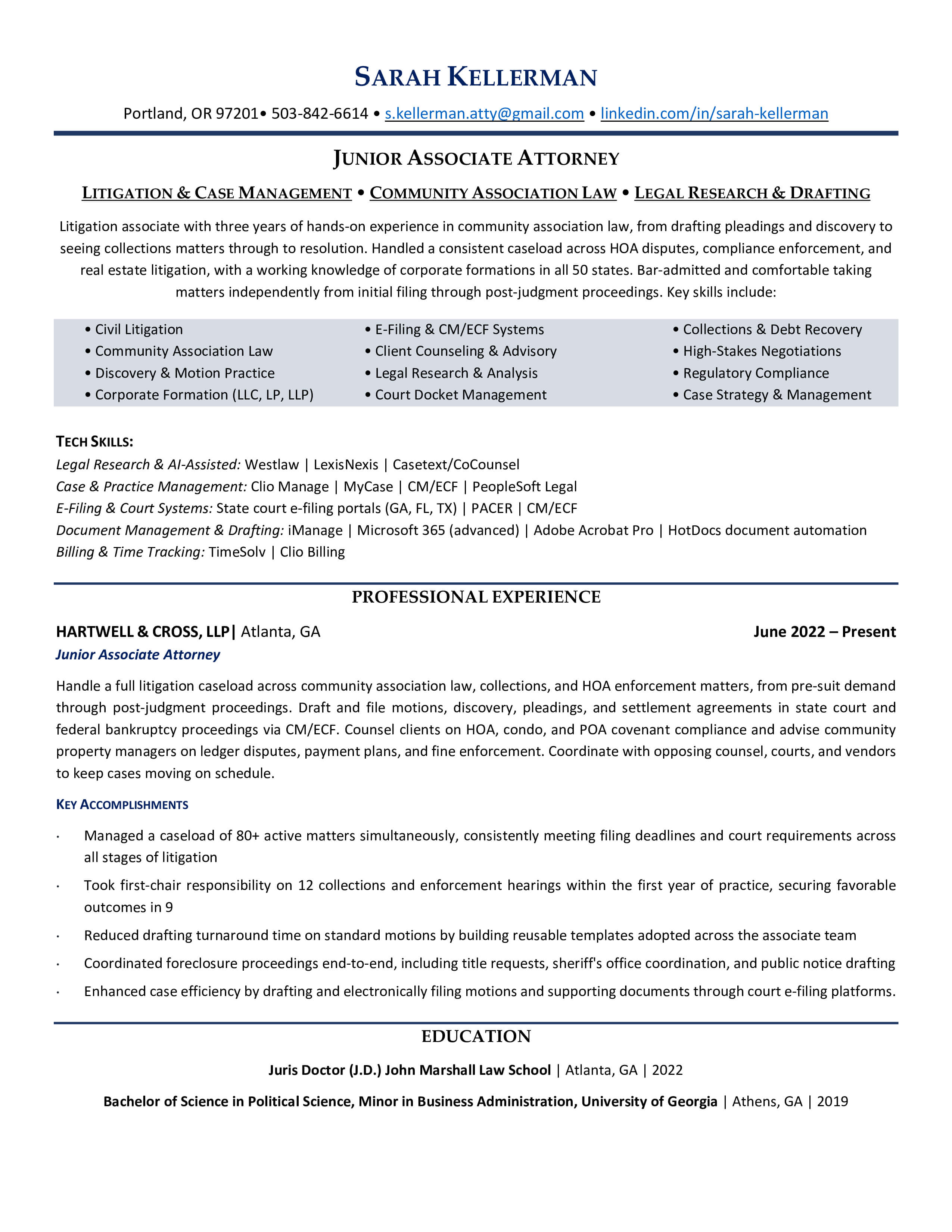

What you should highlight on your lawyer's resume
Most lawyer resume guides stop at "list your experience and education." This one won't, because the legal profession is in a period of genuine transition, and your resume may need to reflect that.
Pivoting practice areas
Some practice areas are contracting in ways that aren't temporary: mass tort litigation, BigLaw real estate (they took a hit when deal flow dried up after 2022 interest rate hikes), and immigration, to name a few. Certain transactional practices that rode the crypto and SPAC waves are now significantly quieter, as well.
If you're in one of these areas and think about moving, the honest reality is that career pivots out of law, or even lateral moves across practice areas, are harder now than they've been in a while.
Law firm hiring has tightened across the board, and most firms prefer someone who's already done the specific work over someone who can plausibly learn it. That's not a reason to stay put in a miserable or shrinking specialty, but it should calibrate your expectations going in.
The pivot resume works differently from a standard legal resume in this situation. Rather than leading with your practice area (which might immediately signal "❌ wrong background"), it opens with a summary that foregrounds the transferable layer: regulatory instincts, client management experience, transactional judgment, etc.
Opening your own practice
Solo practitioners and small firm founders often undersell their business development experience on their resumes. If you've built a book, say so and quantify it.
- Developed a client base generating $180K in annual billings within 18 months of launching solo practice.
This is something a lateral hire candidate rarely has. If you're going back to a firm after running your own shop, this is definitely an asset and should be framed as such. Recognizing your entrepreneurial skills should make you feel proud and motivated to showcase your unique value.
Changing direction entirely
Leaving the law entirely is a different challenge. Career changers moving into compliance, legal operations, consulting, or policy work often have more to offer than they realize, but the resume wording has to be very careful. Lean too hard into your legal identity and you look like someone who couldn't make it work in the profession. Lean too soft on it and you bury the credentials that actually give you an edge over other job seekers. Aim for the right positioning, not reinvention, and get that distinction right before you send anything out.
What AI is doing to the legal profession
It is reshaping certain legal roles, and it's worth knowing which ones before you position yourself.
Paralegal work involving document review, contract abstraction, and basic legal research is the most exposed. Tools like Harvey, CoCounsel (by Casetext), and Contract Express can do in minutes what used to take a paralegal hours. Law firms are already reducing paralegal headcount in some practice groups as a result. If you're a paralegal looking to move up, your resume needs to show that your value is in judgment and client-facing work - not document processing.
Legal research as a stand-alone skill is also much less differentiated than it used to be. AI research tools now surface relevant case law fast enough that "strong Westlaw proficiency" doesn't mean much anymore. Your ability to synthesize that research into a strong argument is very much valued, though. That analytical layer that AI can assist with but doesn't replace is what will set you apart.
Attorneys are affected too, but in a more nuanced way. Junior associate work (think drafting memos, first-pass contract review, routine motions) is the category most affected. This is already showing up in hiring: firms are bringing in fewer first and second-year associates than before, relying on AI to do the dirty work. The work doesn't disappear entirely (yet...), but there's less of it being billed at entry-level associate rates.
To sum up, lawyers who understand how to manage AI-assisted workflows and still take responsibility for the quality of the outcome are increasingly valuable and will have less difficulty finding a job. If you've worked with AI tools in a legal context, put it on your resume, don't shy away from them. If you have not, it's time to start upskilling.
Format and length
For most practicing attorneys, one page is too short, and three pages is too long. Two pages is the standard for associates and counsel with 5+ years of experience. Partners with extensive track records can justify more pages, but only if every line earns its place. Here are a few basic resume formatting rules to follow:
- Single-column format with clear headings: avoid sidebars, if not for ATS compliance, then for the cognitive load your resume produces.
- Simple, readable font: Times New Roman can be right for certain firms, but to play on the safe side, go with Arial, Garamond, Calibri, or Georgia.
- Tailored resume: create a master file and customize it to each opportunity. You do not need a full rewrite every time, though - a light edit of your summary and skill section is usually enough.
A note on what Resumeble does differently
At Resumeble, our writers who work on legal resumes have actual familiarity with the profession's conventions - from how bar admissions should be listed to why a First Circuit clerkship deserves a different placement than a state court one. We've written resumes for public defenders pivoting to corporate compliance, BigLaw partners launching boutiques, and in-house counsel going back to private practice.
A lawyer resume isn't just a formatted list of jobs. It's an argument for why you're the right person for this specific role, and it should be built like one.