 Published: 01 May 2026 | 10 min read
 Summarize in ChatGPT
I'll be honest: nurses are my favorite clients to work with. I've thought about why that is, and I still can't fully settle it. Part of me thinks it takes a certain kind of person to choose nursing in the first place — that the profession selects for patience, steadiness, and a genuine orientation toward other people. Another part of me suspects the work itself shapes you over time, that years of high-stakes, high-empathy care build qualities that show up in every interaction, including the ones you have with your resume writer. Either way, when a nurse sits down with me, there's usually a groundedness to the conversation that I don't always find elsewhere. They know what matters and just need help putting it into words.
Why nursing is a particularly strong job market right now
There is real momentum in nursing right now, and it's worth understanding before you sit down to start working on your resume. The Bureau of Labor Statistics projects registered nurse employment to grow 5% through 2034, adding roughly 189,000 openings annually - that's faster than the average across all U.S. occupations. The 2025 NSI National Health Care Retention & RN Staffing Report found hospitals hired approximately 385,000 RNs in 2024 alone, backfilling attrition and expanding staffing simultaneously. Demand is spreading well beyond hospital floors, too: outpatient clinics, rehabilitation facilities, long-term care, and telehealth are all pulling from the same candidate pool.
This matters for resume writing because it changes the dynamic in your favor, which is not something many of our clients can boast at the moment, to be honest. When employers are competing for talent, your resume doesn't need to be defensive. Instead, make it clear and specific, not safe and vague. Hiring managers in nursing are reading dozens of applications from qualified candidates — the ones that get traction are the ones that feel written by someone who knows exactly what they bring to a unit.
What structure a nursing resume should have
A nursing CV follows a standard resume framework, but how you populate it makes all the difference.
1. Contact information and credentials
Put your name at the top, and immediately after it, your credentials: RN, BSN, CCRN, NP-C, whatever you've earned. Recruiters and nurse managers scan for licensure before almost anything else. Your contact information should include a professional email address, your phone number, your city and state, and a LinkedIn profile URL if you've kept it reasonably current.


2. Professional summary
This is a two-to-four sentence paragraph about why you. Avoid the temptation to describe yourself as "compassionate and dedicated" — every nursing (and not nursing, too) resume says that. Instead, anchor the summary to specifics: your specialty, years of experience, and something that gestures toward what you actually do well. For example, a strong registered nurse resume might open:
-Emergency department RN with seven years of experience in Level I trauma centers, including triage, rapid assessment, and care coordination for complex polytrauma patients. Holds a CEN certification and has precepted over a dozen new graduates during high-census periods.
That summary tells a story. It earns the reader's attention.
3. Work experience
List positions in reverse chronological order. For each role, include the hospital or facility name, its location, your title, and dates of employment. Then, under each position, write three to five accomplishment-focused lines rather than a list of duties.
Duty:
-Administered medications and monitored patient vitals.
Accomplishment:
- Managed a five-patient ICU assignment during overnight shifts, including continuous hemodynamic monitoring for post-CABG patients on vasopressor support.
The second version tells a nurse manager what acuity you've handled. Quantify wherever the numbers are meaningful, like patient ratios, HCAHPS scores you contributed to, infection rates, response times, patient satisfaction rankings, etc.
4. Education and certifications
Nursing credentials are non-negotiable inclusions. List your degrees in reverse order, including the institution and graduation year. Follow with certifications (BLS, ACLS, PALS, TNCC, and any specialty certs like CCRN or OCN) along with their expiration dates where relevant. If you're working toward a BSN or MSN, include it with an expected completion date.
5. Skills section
Keep this focused. A skills section in a nursing resume should reflect genuine clinical and professional competencies, not a catch-all of buzzwords. Think along two lines:
- Technical skills (IV placement, foley catheterization, ventilator management, EHR systems like Epic or Cerner).
- Interpersonal (or soft) skills - communication under pressure, patient advocacy, critical thinking when protocols aren't enough.
There's an older assumption that clinical credentials do the heavy lifting in a nursing application, and that personal qualities get sorted out in the interview. That assumption is old. The turnover crisis in nursing — roughly 16% of RNs left positions in 2024 — has made retention a primary concern for healthcare organizations. Facilities are hiring with an eye toward long-term fit, which means they're paying attention to attributes like emotional regulation, conflict resolution, and care coordination across multidisciplinary teams.
The challenge is naming these skills without resorting to adjectives.
Compare:
- Good communicator
vs.
- Collaborated with pharmacy, physical therapy, and case management to coordinate discharge planning for a 22-bed medical-surgical unit
When writing your experience entries, ask yourself whether each line reflects a behavior, a context, and an outcome. If it does, the soft skills are embedded naturally — and they'll read as earned.
Patience, cultural humility, and the ability to deliver difficult information clearly are qualities experienced nurses have in abundance. The task is finding language that shows them rather than names them.
What a strong nurse resume looks like
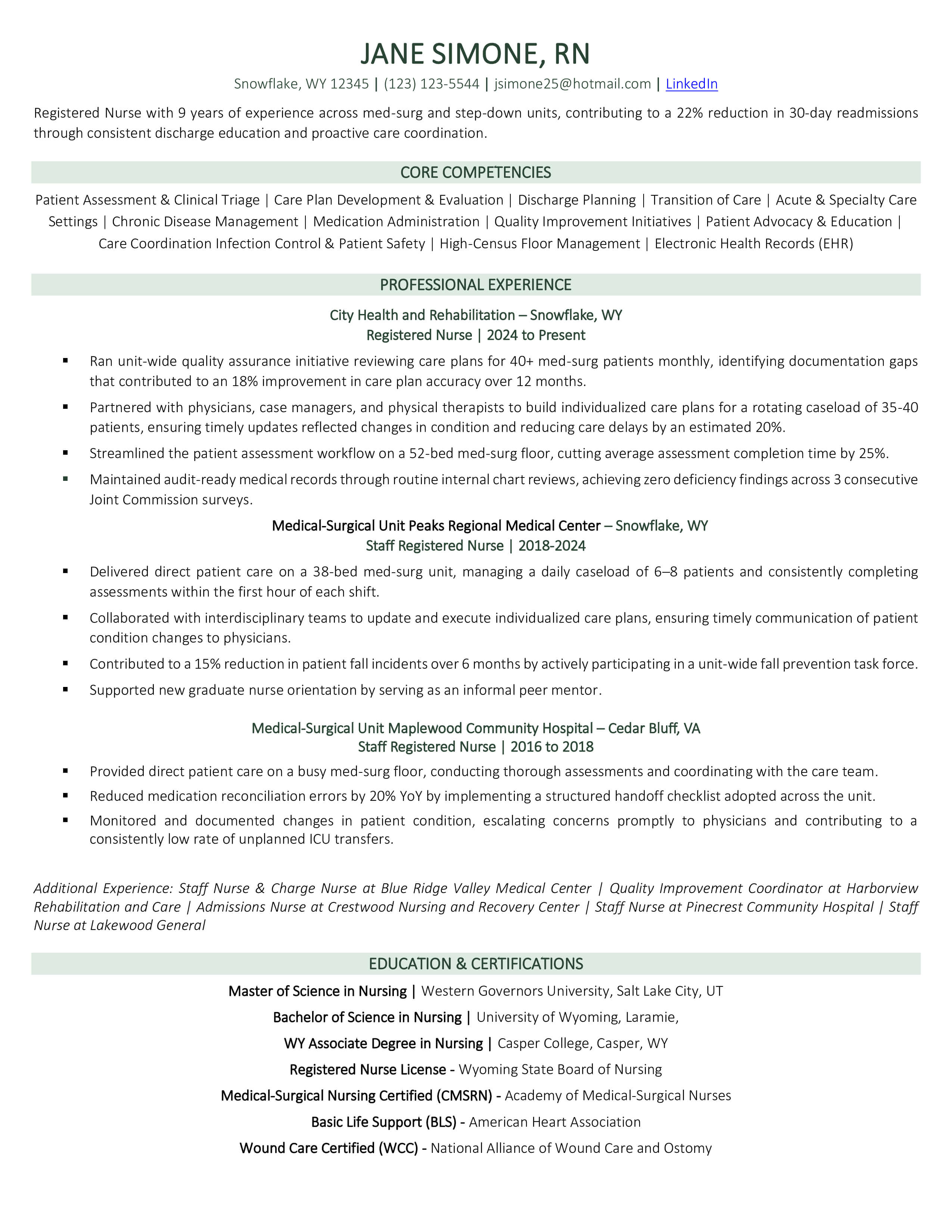
Most resume advice makes more sense once you can see it applied. Below is a sample nursing resume you can download, adapt, and use as a starting point, whether you're updating an existing document or building one from scratch. It reflects the structure, tone, and level of clinical detail that hiring managers in healthcare actually respond to.

Tailor your resume to a specific case
New grad nurse resume
If you're writing a new grad nurse resume, lead with your clinical rotations. Detail the units and patient populations you worked with during your practicum, the preceptors you trained under if they're notable, and any capstone or research projects. Your lack of years isn't a liability you need to apologize for — it's a starting point you build around. Highlight your NCLEX pass, any honors, and certifications earned before graduation.
Nurse practitioner resume
A nurse practitioner resume requires more attention to the scope of practice, especially if you're applying across state lines, where regulations vary. Be explicit about whether you've practiced under a collaborative agreement or with full practice authority, and document diagnostic, prescriptive, and procedural competencies in detail. Patient volume and case mix complexity matter here.
Travel nurse resume
A travel nurse resume has a distinctive challenge: a long list of short-term assignments can look like instability to an untrained eye, but an experienced travel nurse recruiter reads it as breadth. Group your travel contracts under a single section if they share an agency, or list them individually with clear dates and facilities. Emphasize your ability to orient quickly, adapt to new EHR systems, and maintain compliance across different state licensure requirements.
How long should a nursing resume be?
Most nursing resumes should run one to two pages. New graduates can likely keep it to one, while experienced nurses with multiple specialties, certifications, and training roles may need two. Anything beyond that starts to dilute rather than strengthen.
Use a clean, readable font — nothing smaller than 10.5pt. Avoid elaborate design elements that distract from content or create problems for applicant tracking systems. ATS software parses your resume before a human ever sees it, and strange formatting can strip out critical information. Standard section headers, consistent date formatting, and a single-column layout are safe bets for most applications.

Highlight your AI skills
AI is changing nursing in ways that are still unfolding. Clinical decision support tools, predictive deterioration alerts, AI-assisted scheduling, and natural language processing for documentation are already widely in use across healthcare systems. As you sit down to write your resume, consider whether your facility has implemented any AI-driven tools and whether you've engaged with them. Epic's AI features, sepsis prediction algorithms, remote patient monitoring platforms, etc., might become a valuable addition to your skills section! Familiarity with emerging clinical technology signals professional readiness to hiring managers who are navigating the same transition.
On the writing side of things, many nurses are using AI tools to draft or refine their resumes. There's nothing wrong with that as a starting point. The risk is submitting something that reads generic — polished but impersonal, technically correct but stripped of the specific texture that makes your career legible. A resume written with AI assistance should still sound like you: the unit you know, the patient population you've served, the situations that shaped how you work. If you're uncertain whether your draft reads authentically, the career writers at Resumeble can help sharpen it into something that holds up under scrutiny.
What to leave out
Nursing resume examples you find online might include unnecessary details: physical address beyond city and state, references listed on the resume itself, an "Objective" statement that restates your desire to work in healthcare, personal attributes that can't be verified. Leave all of that out.
If you have clinical experience from another country, include it — with context about licensure status and NCLEX completion.
Gaps in employment are increasingly common in nursing, given the burnout and attrition the profession has experienced since 2020. A brief note in your summary or cover letter usually addresses it sufficiently. You don't owe a reader more explanation than that.
-
 City and state (location only)
-
Credentials and licensure numbers
-
Certifications with expiration dates
-
A brief summary note addressing employment gaps (if you have any)
- International clinical experience (with NCLEX status noted)
-
 Full home address
-
"References available upon request"
- Objective statements restating the obvious
- Unverifiable personal attributes ("compassionate," "dedicated")
Putting the final touches
Learning how to write a nurse resume is mostly a matter of learning to trust specificity. The detail you're tempted to leave out (the acuity, the patient ratio, the protocol you helped revise) is precisely what separates your resume from the one before it in the pile. Nursing is a field where the stakes are visible, and experience is earned shift by shift. Your resume should reflect that.
If you want a professional to review your draft or build the document from scratch, Resumeble's team includes writers with healthcare industry experience who understand how to position clinical backgrounds for competitive roles. Whether you're a new grad navigating your first application or an experienced nurse practitioner exploring a specialty change, getting the resume right is worth the time.