 Published: 04 May 2026 | 8 min read
 Summarize in ChatGPT
Project management used to be a fairly stable career. You learned the methodology — Agile, Waterfall, PMP, take your pick — earned the certification, built a track record of delivered projects, and the work found you. That era is over.
What project managers actually do
Ask ten people what a project manager does, and you'll get ten different answers. That's part of the problem.
At its core, PM work is about moving an initiative from intention to completion — on time, within budget, without burning the people doing the work. The more accurate description, though, is that project managers are information gatekeepers. They sit at the intersection of every stakeholder, every timeline, every dependency, and every risk. They know what everyone else is doing, when, and why — and they catch problems before those problems become visible to the people who will fire someone over them.
The PM role demands a specific kind of person (this is where the soft skills come in): organized (enough to track dozens of moving parts), socially skilled, calm under pressure to make clear decisions when priorities are at odds, and technical. The work is relational as much as operational.
How to write a project manager resume that gets read
Here are the project manager resume tips that matter most right now:
1. Lead with results, not responsibilities
Every bullet point in your document section should answer the question 'why?'. And answer it with numbers as clearly and optimally as possible. Example:
✅ Managed a team of 12 to deliver ERP implementation 3 weeks ahead of schedule, reducing go-live costs by $140K.
❌ Coordinated cross-functional teams across multiple organizational levels to collaboratively facilitate a more streamlined and efficient approach to the overall delivery timeline.
2. Tailor it to each role
Job descriptions contain the exact language hiring managers and ATS systems are scanning for. If a posting says "program governance" and your resume says "oversight," you may not make the cut. Read carefully, match deliberately, and don't stuff in terms that don't reflect your actual experience.

3. Make the work scope visible
Budget size, team members, how many workstreams you managed, geographic complexity - these all can give context to what you have achieved that just job titles can't. A PM who oversaw a $2M implementation and a PM who oversaw a $40M transformation are different candidates. Your resume should make that clear.
4. Don't bury your certifications
PMP, PMI-ACP, CSM, PRINCE2 are all still very important and should be listed prominently. Important: make sure they're current. A lapsed certification can raise more questions than a missing one.
5. Address your AI competency
Do not write "familiar with AI tools" or "Write emails with ChatGPT". Name the platforms, describe how you deployed them, and tie it to results. For example:
Designed and deployed Clause-assisted project tracking to reduce status reporting time by 40%
6. Keep the format clean
Your resume should be two pages of consistent formatting with no graphics, photos, or images, and no objective statement. Use a clean font, clear section labels, and enough white space that makes the document easy to read (walls of text will unnecessarily complicate your resume).
7. Nail those keywords
Review a few job postings in your target roles and notice which terms appear repeatedly. Those are the words your resume should include (but make those contextual, not crammed into a skills list at the bottom of your file).
How AI is changing project management
Let's be honest about this: project management is indeed under threat. AI has not eliminated it entirely, but it did compress the support layer sitting beneath.
Roles such as coordinators, junior PMs, etc., that handled scheduling, status updates, meeting summaries, and routine documentation are 100% going to disappear in the coming months. What remains is a lean, often 1- to 2-person team, and each person on that team is expected to carry more of the cognitive load.
This tendency results in fewer total PM roles available on the job market, more competition per opening, and a higher baseline expectation for what a PM should be able to do on day 1. Companies that once had a PM, a program coordinator, and a PMO analyst are now expecting one person to cover significant portions of all three.
If you are a PM who has not updated their toolkit since 2019, the job search will be a punishing experience, no matter how many years you have under your belt.
How to stay in project management in AI era
Staying in PM is absolutely viable, but you need to reposition what you offer.
The new must-haves alongside the traditional PM skillset are worth being specific about. Budget management, risk frameworks, stakeholder communication, and methodology fluency (Agile, Scrum, PMP, PRINCE2) remain the foundation. Nobody is throwing those out.
Pay attention to AI skills
What's being added on top is the expectation that you are AI-literate in a practical sense — not that you have a ChatGPT account, but that you understand how to build and supervise AI-assisted workflows, interpret outputs critically, and know where automation creates risk rather than efficiency.
Automate data analysis
Data analysis is another area where expectations have shifted absolutely and unconditionally. You want to be a PM who can pull from a dashboard, read a burndown chart, and translate numbers into a business strategy within one working day. Candidates like this are in a different conversation with recruiters than those who rely on junior analysts to process data for them.
Underline your soft skills
Strategic thinking has always been valued on paper, but it's actually necessary now. With diminished layers between execution and leadership, PMs who can speak the language of business outcomes have a real advantage. Knowing that you shipped a product on time is compelling, but knowing why it mattered, what it cost to build, what revenue it enabled, and what you'd do differently is priceless.
The soft skills that used to be considered nice-to-have (think conflict resolution, change management, organizational psychology, etc.) are now the difference between surviving a reduction in force and being the one who makes the cut.
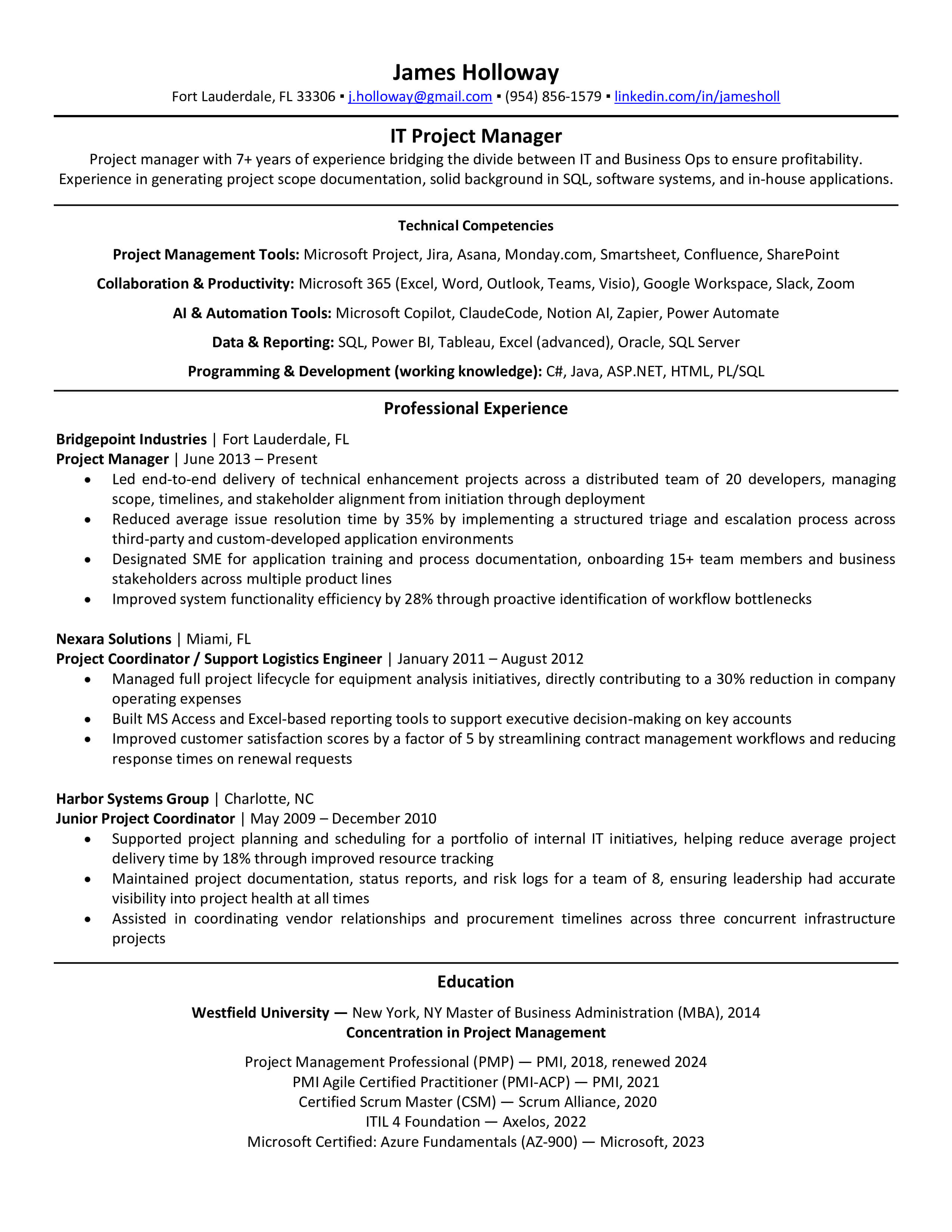
Project manager resume example

If you want to transition out of project management
Some experienced PMs are reading the market and deciding to pivot rather than compete in a tightening field. That's a rational choice, and the transferable skill set is genuinely strong.
Operations management is a natural landing spot for PMs who've managed budgets, vendors, and inter-departmental dependencies. These translate really well into COO and COO-adjacent roles, particularly in small- to mid-size companies that need someone who can both plan and execute.
Product management is another strong path, especially for PMs with close exposure to development teams and a feel for user decisions. Business analysis, program management, and management consulting are all viable options, as is change management as a specialty — organizations undergoing digital transformation are consistently looking for people who understand both project execution and the human side of organizational change.
For a pivot like this, though, the resume work is significant. You need to reframe your history in the language of the target role, pull forward the most relevant experiences, and be honest about where the gaps are. A PM resume written for another PM job won't get you into product management or operations. The framing has to change.
Our honest take on what's ahead
Landing a project manager role in the current market will take significantly longer than it used to, even for strong candidates. Companies are getting choosier, and the interview process is becoming longer. The volume of applicants per opening is higher, and the bar for showing your strategic value has risen significantly.
That doesn't mean the path is closed, but it does mean that your resume and how you position yourself must be sharper than they were a few years ago. PMs who can show a clear record of business impact, demonstrate that they've kept their skills current, and communicate with precision are still getting hired.
We work with project managers at every stage here, at Resumeble: people refreshing a resume after a decade with the same employer, career changers rethinking their trajectory, and mid-career professionals navigating a market that has shifted under their feet. The project manager resume examples we build for clients are grounded in real outcomes, honest positioning, and language that reflects how hiring teams actually evaluate candidates today.
If you're unsure where your resume stands, a professional resume review can give you a clear assessment and help create a document that genuinely represents where you are in your career.