
Create a nurse resume guide
According to Nursingworld.org, the US Bureau of Labor Statistics projects 194,500 average annual openings for registered nurses (RN) between 2020 and 2030, with employment projected to grow 9%. The demand for RNs, who represent the largest group of healthcare professionals, increased due to higher demand from aging individuals and patients with chronic diseases. The expected retirement of RNs aged 50 and above may also contribute to nurse job vacancies.
Your skills and experience as a nurse will come in handy in the coming years, whether you’re an RN, a Licensed Practical Nurse (LPN), or a Certified Nursing Assistant (CNA). If you specialize in certain fields, such as pediatrics, obstetrics, or oncology, demand may even be higher. It’s important to make your experience and skills prominent when you apply for a nursing job.
Discover how to create a nurse professional resume to make your capabilities stand out in the competitive healthcare industry. Check out Resumeble’s nurse resume writing guide below or download a free resume sample.
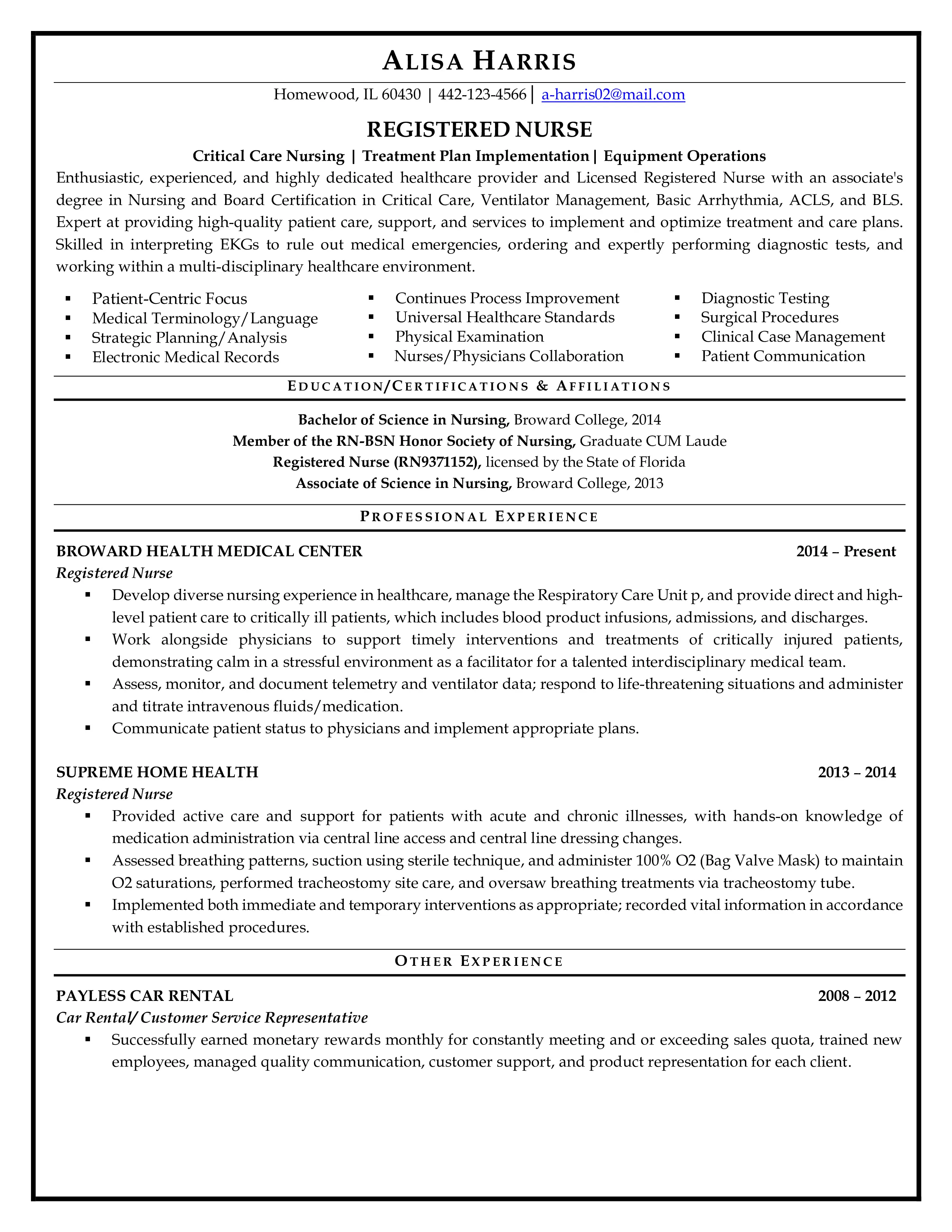





Creating your nurse resume
Be one of the thousands of nurses who will keep the healthcare industry thriving. Create your registered nurse resume today!
What is a nursing resume?
A nurse resume provides relevant information and a summary of your career progression as a nurse practitioner. It includes your work experience, skills, educational background, and training experience in the field of nursing. It also reflects your competency and dedication to your job, as well as your values and philosophy as a healthcare professional.
A nurse resume's goal is to bring the attention of a prospective employer to your relevant skills that will be a good fit for their job posting. It's essential to find a resume writing service familiar with nursing skills and specializations that can effectively highlight your professional experiences. Learn more about this in the next section.
Create your nurse resume
- Prepare the information. Before you start writing, make sure the information you need to stand out in a particular job posting is ready. Adjust your resume according to the requirements of the role. No two prospective employers should receive the same resumes. Examples of data to prepare:
- Previous employers and inclusive dates
- Accomplishments in each role
- Relevant certifications
- Type of work you did
- Patient load
- Efficiency rates
- Number of team members supervised
- Data related to your specializations
- Identify a format or design. There are 3 common ways to format a resume, which address different categories of nurses.
- Reverse-chronological Format – best for nurses with a steady and extensive work experience. It presents your nursing career progression in the same or related fields.
- Functional Format – good for new graduates or healthcare professionals changing fields. It highlights your skills more than your chronological work experience.
- Combination Format – useful for nurses in mid-career. It presents a good mix of skills and experience.
- Write your resume. Find some of the best resume outline tips below that will help you form a compelling, attention-grabbing resume. Here are the common sections of a nurse resume:
- Header
- Professional summary
- Work experience
- Skills
- Certifications
- Awards, recognitions, and other achievements
Header or contact information
No matter how you design your resume, your header should always contain your contact information. If your resume attracts the attention of recruiters, your header will be the first section they’ll check to know how to contact you. Place your contact information in a prominent location, such as at the top of the page or above the sidebar.
Include the following:
- Full name – the name that appears on your professional or legal documents
- Nursing title or degree
- Phone number – a number you often use, preferably not an unattended landline
- Email address – a professional email, preferably with your name on it. Avoid using your current workplace email or a casual-sounding one.
- Location – city and state
- LinkedIn profile – a reliable reference for hiring managers.
Professional summary
Create a 2 to 3-sentence paragraph summarizing your relevant professional experience and career goals. Include the number of years of nursing experience, skills relevant to the job posting, specializations, certifications, and career achievements.
If you’re a nursing student looking for a job or a new nurse graduate, you can write a career objective as an alternative to a professional summary. The Objectives section of your resume should give employers a good first impression. You may list down the skills you learned in school and support them with your career objectives. This will inform recruiters that you are a conscientious person, a trait that is useful for a nurse aspirant. Here is a list of resume objectives as a reference.
Work experience
This section provides more details about the aspects you mentioned in your professional summary. It lists each of your nursing jobs, responsibilities, and accomplishments in bulleted form. Present each nursing job this way:
- Job title | Employment dates
- Company/organization name | City, state
- Responsibility and outcome
Start each detailed description with an action word, followed by the specific task, the reason or goal for doing it, and the outcome or quantifiable result. Do this for every nursing job entry. Experts recommend writing 5 responsibilities for the most recent role and 3 for previous jobs.
Tailor your resume according to the job description and your specialization. If you have extensive experience in a specific field of nursing, your resume should clearly demonstrate it. Update your resume as you gain more experience, to distinguish yourself from newer nurses. Below are examples of items you can include in your resume according to your level of expertise.
Experienced registered nurse (5 years and above)
- Special tasks – demonstrates your level of expertise, the extent of trust given to you by previous employers, and your ability to handle challenging duties
- Supervisory responsibilities or department designations – shows leadership and management skills, lets employers know your strengths that match their needs
- Varied range of tasks – highlights flexibility and growth as a nurse, showing career progression
Entry-level RN
- Hands-on or practicum experience in major hospitals – shows exposure to high medical environments, implies ample learning and training gained
- Special assignments such as the ICU – demonstrates ability to handle quality care in emotionally charged or critical care settings
- Certifications and state licenses – show basic knowledge and mastery of nursing procedures
Senior-level RN
- Leadership experience – should mention the team size, clinical workflow improvements done, and quantitative results; shows influence in healthcare efficiency and knowledge transfer
- Satisfaction ratings – demonstrate strength in non-technical skills that improve patient experience, with quantitative proof to show
- Specialized experience (e.g., post-operative and trauma care) – positions you as an expert in specific fields
- Advanced certifications – show more than basic knowledge and expertise
School nurse
- Experience specific to the school environment – should include the student population you treated per year and their common conditions
- Types of injuries or health emergencies handled – shows expertise in pediatric nursing and experience in treating a broad range of patient cases
- Certifications – preferably relevant to the school setting, such as pediatric certifications
- Health programs or initiatives launched (if any) – shows proactiveness in your job and potential to become a lead nurse
Emergency room nurse
- Patient assessment capability – shows your personal process of triaging patients and how it contributes to efficiency
- Teams or medical practitioners you work with – demonstrates collaborative ability to create an emergency care plan for patients
- Coaching, training, and supervision experience (if a senior ER nurse) – include team sizes managed, coaching and mentorship results, training delivered to student nurses
- Treatments administered – treatments for life-threatening situations and crucial medications recommended for critical cases
Flight nurse
- In-flight critical care given – includes emergency treatments or first-aid activities for various patient categories; demonstrates breadth of skills
- Medical protocols administered in high altitude – such as ACLS and PALS; presents expertise in these guidelines
- Pre-flight preparations, such as emergency equipment and checklists – shows proactiveness; must include efficiency results
Skills
The skills section can be a primary differentiator between, for instance, a senior-level nurse with extensive experience in one field or company and a mid-level nurse with a broad range of roles in various fields and organizations. If your work experience is not as significant, you can still make your resume stand out with your skills. What should you write in this section?
List both your hard or technical skills and soft skills. Hard skills demonstrate your prowess in procedures, equipment handling, and clinical operations. Soft skills emphasize characteristics and personality traits valuable to patient interaction, collaboration with healthcare colleagues, and the creation of solutions for unusual situations.
Here are examples of technical skills:
- Wound care
- IV insertion
- Proficiency in EHR/EMR systems
- Operation of ventilators, monitors, imaging tech, and infusion pumps
- Checking and monitoring of vital signs
Here are examples of soft skills:
- Communication
- Teamwork
- Compassion and empathy
- Time management and organization
- Critical thinking and problem solving
Adapting your skills section to your level of expertise is recommended to distinguish you from other nurse applicants. Some of the following skills are specific to the nurse’s specializations:
- Pediatric nurse - child development, family-centered care
- ICU nurse - critical care, ventilator management, rapid response
- Emergency room nurse – triage, trauma care, quick decision-making
- Holistic nurse – stress management techniques, psychiatric medication, massage
- New nurse graduate - clinical rotations, academic achievements, eagerness to learn
- Progressive care nurse – critical thinking, proficiency with medical software
- Charge nurse – familiarity with operations, computer knowledge, and supplies monitoring
- Operating room nurse – surgical instrumentation, intraoperative monitoring, aseptic technique
How to present your nursing skills:
- Write a concise bulleted list for easy scanning.
- Prioritize skills most relevant to the role.
- Tailor the skills section to the job description.
- Use keywords that match the job posting.
Education
Your educational background is as important as your work experience. Employers want to know the level of education and training you received and where you got it. Present your school credentials in reverse chronological order, from the most recent academic degree or certification program to the oldest.
The most common nursing programs include:
- Bachelor of science in nursing (BSN)
- Associate degree in nursing (ADN)
- Registered nurse certificate (RN)
- Licensed practical nurse program (LPN)
- Master of science in nursing (MSN)
Certifications and licenses
Certifications and licenses are essential proofs of nursing qualifications, and are often the distinctive credentials for specialized job positions. Make sure you mention your state- issued Registered Nurse (RN) or Licensed Practical/Vocational Nurse (LPN/LVN) license, which is a fundamental requirement in nursing jobs, and life support certifications, such as Basic Life Support (BLS), Advanced Cardiovascular Life Support (ACLS), Pediatric Advanced Life Support (PALS), and other certifications and licenses.
If you hold an Advanced Practice Registered Nurse (APRN) license, approved credentials for foreign-educated nurses, and state-specific or multistate licenses such as the NLC, highlight them. Here are some specialty-specific certifications or licenses for nurses:
Military nurses
- TCCC (Tactical Combat Casualty Care) – Essential for deployed and field nurses
- C4 (Combat Casualty Care Course) – Army-specific trauma care training
- ATLS (Advanced Trauma Life Support) – Common for trauma and emergency roles
- En Route Care Course (ERCC) – For aeromedical evacuation nurses
- Flight Nurse Certification (military-trained) – For air evacuation units
- CCRN – Critical Care Registered Nurse
- CEN – Certified Emergency Nurse
- CNOR – Certified Perioperative Nurse
- CRRN – Certified Rehabilitation Registered Nurse
- OCN – Oncology Certified Nurse
- RNC-OB / RNC-MNN – Obstetric or Maternal-Newborn Nursing
- CPEN – Certified Pediatric Emergency Nurse
- CRNA (Certified Registered Nurse Anesthetist) – Highly common in military anesthesia roles
- PMH-BC – Psychiatric-Mental Health Nursing Certification
- Case Management (CCM) – Common for veteran care coordination
Rehabilitation nurses
- CRRN – Primary and most recognized rehab nursing certification
- CCRN – For rehab nurses working with medically complex or critical patients
- CMSRN – Certified Medical-Surgical Registered Nurse (common in inpatient rehab
- units)
- SCRN (Stroke Certified Registered Nurse)
- CNRN (Certified Neuroscience Registered Nurse)
- TBI Certification – Traumatic Brain Injury care training
- Spinal Cord Injury (SCI) Certification – Specialized rehab training
- Pain Management Nursing Certification (RN-BC)
- GNP / AGNP-BC – Advanced practice roles with older adult rehab patients
- Wound Care Certification (WOCN or CWCN) – Very common in rehab settings
Surgical nurses
- CNOR (Certified Perioperative Nurse) – Most recognized OR nursing certification
- CSSM (Certified Surgical Services Manager) – Leadership/management in surgical
- services
- CMSRN – Certified Medical-Surgical Registered Nurse (pre-op/post-op units)
- CAPA (Certified Ambulatory Perianesthesia Nurse – Phase I)
- CPAN (Certified Post Anesthesia Nurse – Phase II)
- RNFA (Registered Nurse First Assistant) – Advanced intraoperative role
- CRNFA – Certified Registered Nurse First Assistant
- CEN – For trauma or emergency surgical nurses
- CCRN – For surgical ICU nurses
- CNS-BC (Clinical Nurse Specialist) – Surgical or perioperative specialization
- ONC (Orthopaedic Nurse Certification) – Orthopedic surgery units
As a rule of thumb for military nurse resumes, indicate your civilian licenses first, followed by life-support certifications, and then military-specific and trauma credentials. Find out more about nursing certifications here, or check out the complete list of licenses you can include in your resume.
When presenting your certifications and licenses, include the name of the license or certificate, the organization that issued it, and the year you earned it.
Advance your healthcare career with a compelling registered nurse resume. Let Resumeble’s outline guide you, or check out our free downloadable nurse resume sample above for more ideas.
Boost your career with a persuasive registered nurse resume from Resumeble
Showcase your best skills and professional accomplishments as a nurse with our resume writing service. Get a professional resume from our expert writers!