
Create impact with your web developer resume and join one of the fastest-growing, dynamic job markets in the world
According to the Bureau of Labor Statistics, employment opportunities for web developers and digital designersare projected to grow by 7% from 2024 to 2034, which is higher than the average rate for most other occupations. The agency forecasts an average of 14,500 openings per year over the next 10 years.
Contrary to speculation, the web development sector is thriving, driven by the popularity of e-commerce and the rise of digital retail marketplaces. As a web developer or digital design specialist, your options won’t be facing downtime anytime soon. In fact, new roles are evolving with the emergence of new technology and infrastructure, especially AI.
It’s best to be prepared for when the perfect opportunity or dream role comes your way. You can attract the right employer with the right background and skills. Create a web developer resume today that will present your strengths and qualifications purposefully. Check out Resumeble’s web developer resume examples and writing guide. Download a free sample today.
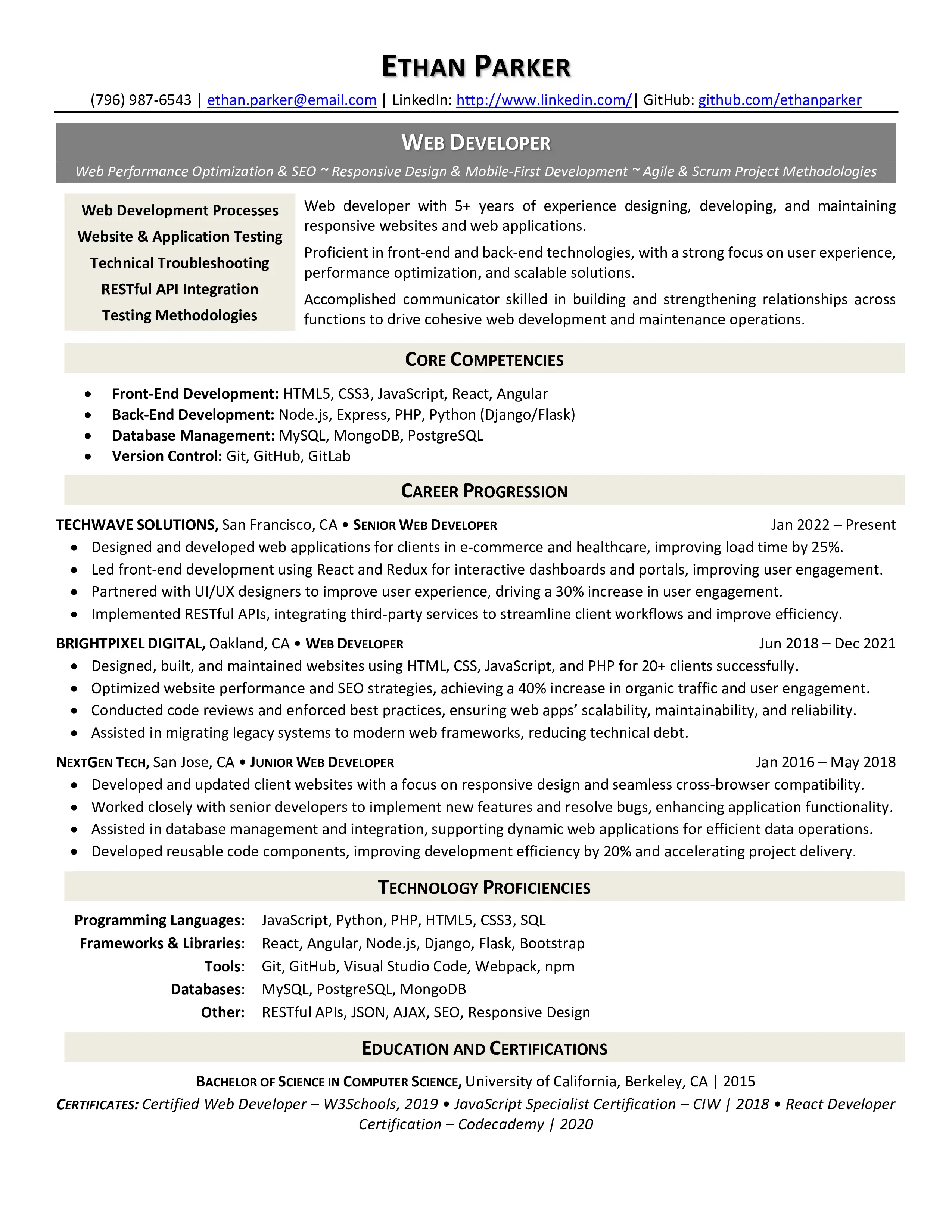





Create your web developer resume
Be part of the new generation of web design and development specialists who enhance the internet infrastructure. Create your web developer resume today.
What is a web developer?
A web developer essentially designs, builds, and maintains websites and mobile apps. They also optimize the user interface and improve site functionality and coding. They may handle front-end or backend roles involving aspects of coding, graphic design, marketing, search engine optimization, database management, or analytics. They may be degree holders in web design, graphic design, computer science, or information technology, or trained in the fundamental skills of programming and design.
Web developer jobs and titles differ, based on level of expertise, type of work, and employment arrangement. The work they do may include any of the following:
- Meet with clients to discuss website needs, problems, and goals
- Plan site layout with other designers, integrating multimedia content
- Write or review code, such as HTML, XML, or JavaScript, for websites
- Design user interfaces to improve visitor engagement, incorporating interactive elements like graphics and navigation menus
- Create website prototypes and mockups for client presentation and review
- Test and debug web applications
- Collaborate with other developers, designers, and stakeholders
- Monitor website traffic and behavior, troubleshooting flaws affecting site performance and user experience
What is a web developer resume?
A web developer’s resume summarizes their professional experience, relevant skills, education, training, and other accomplishments. It’s thoughtfully packaged to showcase their knowledge, strengths, and skills in web development and specific sub-specialties. It’s designed to attract employers seeking qualified candidates, and applicant tracking systems searching for the perfect resume that matches job postings.
A resume tailored to your target web developer position is your first opportunity to impress recruiters. Learning more about what employers seek can help you present relevant qualifications in your resume that will help increase your chances of getting the job.
Create a web developer resume that employers cannot resist, with the help of one of thetop federal resume writing services. Check out our resume outlineand writing guide in the next section.
Writing your web developer resume
- Gather and organize your professional information Begin by compiling all relevant career details. Carefully review the job description to understand the employer’s requirements and expectations. Identify keywords from the job posting that you can embed in your work history and skills sections. Customize your resume to align your most relevant skills, experience, and qualifications with each role.
Preparing your information in advance allows you to present your background in a structured, concise, and strategic manner, increasing your chances of making a strong professional impression.
Information to prepare:- Names of previous employers and dates of employment
- Key achievements and measurable results in each position
- Professional certifications, licenses, and educational or training credentials
- Primary responsibilities and scope of duties performed
- Relevant technical and soft skills
- Performance metrics and documented contributions
- Popular words to describe yourselfand your accomplishments
Choose the most appropriate resume format Selecting the right resume format is crucial, as each structure underscores different priorities. Understanding how each format presents information will help you highlight your qualifications strategically in the most compelling manner.
Reverse-chronological format – This format is considered the standard for most resumes. It’s ideal for web developers or designers with steady and consistent work experience. It lists roles, beginning with the most recent, and works backward. It shows your career progression and emphasizes your most recent roles and achievements. It is also the most ATS-friendly of all formats.
The only downside is if you switch companies or jobs often. The reverse-chronological format can’t hide your career gaps.Functional format – The functional format is best suited for recent graduates, entry- level candidates, or professionals transitioning into the web development field from a different industry or specialization. It prioritizes skills and core competencies over employment history. It lists only the companies you worked at and doesn’t provide details on responsibilities and outcomes. Instead, it emphasizes transferable abilities and relevant skills.
If your work experience is limited, this format still allows you to make a good impression with your skills. However, if your goal is to mask your career gaps, employers will likely discover them anyway.Hybrid or combination format – The combination format blends key skills with detailed professional history. It presents like the reverse-chronological format, but under the Professional Experience section, the roles are grouped by the skills they represent.
The advantage of this format is that recruiters can scan work experiences based on the skills they need. If you can customize your professional history based on the job description skills, you can easily guide the attention of the recruiter to the work background that’s most relevant to them.
Another way you can use the hybrid format is by extracting all your achievements and placing them under a separate section, “Summary of Skills.” This will give hiring managers a highly targeted resume where the skills they require are presented as value from actual job results.
- Start writing your resume While using AI tools likeChatGPT for your next resume writingcan provide guidance, your resume should ultimately reflect your unique experience, achievements, and professional value. Use a clear, structured framework that effectively highlights your qualifications, strengths, and career progression.
A well-organized and thoughtfully written resume enables hiring managers to quickly assess your suitability for the role. Following a proven format ensures your information is presented logically and professionally, increasing readability and impact.
Standard sections of a web developer resume:- Contact information
- Professional summary (or career objective)
- Key skills (technical and managerial)
- Professional experience
- Education
- Certifications
- Projects
- Optional additional sections - Social profiles, interests, hobbies, extra-curricular achievements, awards, and recognitions
Contact Information
The contact information section, also known as the header, should be at the top of the page. Some write their contact details on top of the resume sidebar. That can work, as long as the information is in a prominent spot, as it’s the only way recruiters can easily reach you.
Provide the following information in your Contact Information section:
- Full name – your official name as it appears on your professional or legal records
- Phone number – a working number you use and access regularly, preferably a mobile phone number that is not your current employer’s
- Email address – a professional email address, ideally one that includes your name, for easy reference
- Location – city and state
- LinkedIn profile or professional website – an updated LinkedIn profile or portfolio that supports your resume
Professional summary
Write a concise professional summary of about 2-3 sentences that highlights your most relevant skills and how you can use those skills to address the employer’s high-priority needs. Web developers will likely be adept in a range of programming languages, but the summary doesn’t have to enumerate those technical proficiencies – yet. Leave that for the technical skills section.
Instead, present your abilities and how they can be valuable to the company without sounding too technical. Unless you need to turn this part into a Career Objective section because you are a new graduate and have no work background to speak of, you don’t have to mention your career objectives either.
If you need to turn the section into a Career Objective section in place of a Professional Summary, write the skills you gained through training and education, and connect them to your professional goals as an aspiring web developer. Include skills that will help recruiters recognize your potential, work ethic, and commitment to growth.
Technical skills
This section is any web developer’s chance to brag about their technical know-how, but the challenge is to do it with readability and benefit in mind. Always remember that recruiters want to understand why those alphanumeric certifications would be good for the employer and the role.
Web developers are expected to know the following skills to have flexibility in finding jobs:
- Coding
- Responsive web design
- Technical SEO
- Version control
- Visual design
But if you have an extensive range of technical skills, experts suggest doing more than enumerating them. Group your technical skills to give context. Below is an example from Smashing Magazine of technical skills grouped for better readability and scanning, instead of a random list. It shows hiring managers the big picture of a web developer’s expertise.
- Web technologies & frameworks: Angular 4, HTML5, CSS3.0, Kendo UI, PHP
- Scripts/UI: JavaScript, OOJS, JQuery, AJAX, BootStrap
- Database and ORM: MySQL
- Web debug tools: Mozilla Firebug (debugger), Chrome developer tools
- Application/Web server: Apache Tomcat 6
- Versioning and other tools: Git, Bitbucket, Jira
- Deployment tools: Docker, Maven, CiCd, Jenkins
By organizing your technical skills into categories, it would be easy for a hiring manager to check your capability in the tools and programs they use.
Managerial skills
Why would a web developer need managerial skills? The answer is simple. There are many web developers a company can hire, and if they hire a freelancer, they could even save on costs. But the fact that some employers are posting a full-time job means they are looking for someone who offers more than a freelancer’s capabilities. They need someone they can eventually rely on to lead a team or manage a project.
If you’re looking for a full-time role, the managerial skills section can be your trump card. Not all web developers may have leadership or management skills. If you do, you will have a greater advantage over other applicants.
So, how should you list project management skills on a resume? Start with the hard, professional skills that you can expound on in your professional experience section, then end with the soft skills. Include only the skills that you can explain in detail during an interview. A few examples of hard skills are:
- Documentation and reporting
- Stakeholder management
- Project management
- Client relationship management
- Issue resolution
- Module management
- Agile methodology
- Team leadership
- UI enhancement
- Requirement gathering
- Code optimization
- Front-end development
Examples of soft skills that may not have a direct connection to managerial prowess, but are crucial for web developers to have include:
- Communication
- Problem solving
- Critical thinking
- Time management
- Teamwork
- Adaptability
- Emotional intelligence
- Self-learning
- Empathy
- Patience
Professional experience
There are many ways a web developer can approach this section without missing a crucial achievement. Some experts recommend writing a master CV first, where you can place everything you’ve ever done in your life, every accomplishment you had in every company, every completed education and academic achievement, every training and certificate you’ve earned. All you have to do is review the job description and pick the items from your master CV that match the requirements.
Another way to make this a compelling section is to ensure it is achievement-based and not responsibility-based. Responsibilities only show what is expected of you and what you do every day. Achievements show hiring managers how you used these daily actions to produce valuable results for your team or organization. Present measurable outcomes to prove your claims.
You may also use subheads to classify your work background. Here is an example of that type of section:
Front-end development
Senior Front-End Developer
- Improved page performance by 40% through code splitting and performance audits.
- Implemented reusable component libraries to streamline UI consistency.
- Ensured accessibility compliance (WCAG 2.1 standards).
Front-End Developer
- Developed responsive websites and progressive web apps.
- Collaborated with UX designers to translate wireframes into interactive interfaces.
- Reduced UI bugs by implementing automated front-end testing
Back-end development
Senior Full-Stack Developer
- Managed AWS infrastructure (EC2, S3, RDS) and CI/CD pipelines.
- Improved database efficiency through indexing and query optimization.
- Implemented secure authentication systems using OAuth and JWT.
Back-End Developer
- Developed server-side applications using Laravel and MySQL.
- Built microservices to support mobile and web applications.
- Maintained data security standards and conducted system audits.
E-commerce and CMS development
E-Commerce Web Developer
- Integrated payment gateways, including Stripe and PayPal.
- Improved conversion rates by optimizing checkout processes.
- Implemented SEO best practices and schema markup.
CMS Developer
- Developed custom themes and plugins based on client requirements.
- Provided ongoing website maintenance and performance updates.
- Trained clients on CMS usage and content management workflows.
Leadership and project management
Lead Web Developer
- Supervised a team of 6 developers across multiple web projects.
- Conducted code reviews and enforced development standards.
- Coordinated sprint planning and backlog refinement sessions.
Project-Based Freelance Web Developer
- Managed 25+ client websites from concept to deployment.
- Gathered requirements, defined project scope, and created timelines.
- Delivered custom-built solutions for startups and small businesses.
For entry-level developers, you can compete with other applicants who have had a few years of experience by doing the following:
- Include all freelance projects you’ve done
- Boost your GitHub profile and the code you posted
- Look for open-source projects you can contribute to and include them in your resume
- List down any hackathons or local developer meetups you helped organize or participated in
For readability, use concise bullet points per job on your resume to list each position. Follow this format:
Job Title | Employment Dates
Company or Organization | City, State
Action-oriented responsibility, purpose, and measurable achievements Start each entry with a strong action word and your responsibility, followed by a brief explanation of how the task performed achieved positive or excellent results. Let the job description guide you into how you will frame your experience and accomplishments.
For conciseness and impact, provide five (5) bullet points for your current or most recent job title and three (3) bullets for previous roles. Customize your bullet entries to align with the job description. It’s important to update your resume and bullets as you gain additional experience to provide the most updated information in your resume.
Web developers work in a range of environments, such as company-based IT departments, marketing companies, tech companies, and programming companies. As a web developer applicant, it is in your best interest to research the company you’re applying to and learn the kind of work setting they offer so you can better understand their needs.
While web developers are generally categorized as Front-end, Back-end, and Full Stack (can handle both front and back-end), the work environment can create a specific role or title designed for the job. Here are some of the common web developer roles:
COMMON WEB DEVELOPER ROLES & RESPONSIBILITIES
Front-end Developers
- Creates the visual and interactive components of a website or app
- Builds the elements that users interact with, ensuring a positive user experience
- Designs user-friendly or responsive interfaces
- Ensures excellent website performance across various browsers and devices
- Proficient in programming languages like HTML, CSS, and JavaScript, and frameworks like Angular or React.
Back-end Developers
- Handles server-side programming and database management
- Writes and optimizes server-side code
- Builds and manages databases
- Ensures website and application security and scalability
- Proficient in back-end programming languages like PHP, Python, Ruby, Java, and Go.
Full-stack Developers
- Has full capacity to manage every phase of the web development process
- Bridges the gap between front and back-end to ensure seamless performance
- Develops complete proprietary web solutions for companies
- Troubleshoots problems across all layers of the application or site
- Proficient in the full range of tools and frameworks
Web Designers
- A more creative role that focuses on website aesthetics and user experience
- Makes sure the developer’s vision becomes a functional website or app
- Creates visual concepts, layouts, and user-centric designs
- Develops style guides and branding elements
- Proficient in Figma, Adobe XD, and Sketch
E-commerce Developers
- Designs and manages online retail platforms
- Creates secure and user-friendly shopping experiences
- Streamlines order management and payment systems
- Develops secure payment gateways
- Optimizes online store speed and performance
CMS (Content Management Systems) Developers
- Creates custom themes, plugins, or extends the functionalities of current systems
- Creates websites for bloggers, businesses, and government organizations
- Combines web development skills with CMS experience
- Knowledgeable in WordPress, Joomla, and Drupal
DevOps Engineers
- Focuses on combining web development and operational practices
- Streamlines the software delivery process
- Optimizes cloud computing and version control systems
- Automates repetitive processes to save time and reduce risks
- Manages integration pipelines
Cyber Security Web Developers
- Safeguards digital assets and prevents data breaches
- Implements encryption protocols
- Prevents unauthorized access to sensitive data
- Conducts security audits
Mobile Web Developers
- Ensures app’s optimal performance and appearance across devices
- Optimizes websites for mobile device users
- Boosts speed and accessibility for mobile users
- Checks compatibility with various operating systems
Freelance Web Developers
- Creates custom web solutions for startups, small businesses, or individual clients
- Builds and maintains client relationships
- Manages multiple projects simultaneously
- Requires strong time management skills
- Exhibits a proactive approach in securing clients
Education
Your educational background is as essential as your professional experience. Employers can use educational information to assess your preparedness for a job and the sufficiency of your training. According to online career platform Zippia, about 71% of web developers have bachelor’s degrees and 11% have associate degrees. Fourteen percent go on to pursue master’s degrees. More than 40% major in computer science and less than 10% major in information technology, computer engineering, and computer information systems.
Write your educational background following these formats:
- List your degree and institution in concise bullets, starting with the highest educational level.
- If you’re a recent graduate, include your graduation year.
- If you are moving from another specialty to web development, highlight the educational achievement relevant to the latter.
Certifications and certificates
Certifications indicate that you’ve passed an exam to prove your proficiency in a certain technical skill. Certificates show completion of essential training in web development-related tools and technologies. Here are some of the certifications and certificates you can include in your resume:
- Meta React Native Specialization – focuses on programming fundamentals for UI design
- AWS Certified Developer – Associate – focuses on training to develop and deploy applications using AWS platforms and CI/CD workflows
- IBM Back-End Development Professional Certificate – concentrates on back-end tools and technologies like Kubernetes, Docker, and server-side Python
- IBM Full Stack Software Developer Professional Certificate – training to develop, deploy, and scale cloud applications with cloud-native tools and technologies like containers and microservices
- Google UX Design Professional Certificate – training on the entire UX design process
- Web Design for Everybody – covers the use of the Document Object Model (DOM) to modify pages, interactivity development with JavaScript, and the fundamentals of CSS
- Adobe Certified Professional – focuses on industry-standard tools and your ability to pass thorough technical evaluations
- IBM Applied AI Professional Certificate – focuses on key AI concepts like machine learning, deep learning, and neural networks
- Generative AI for Software Developers – trains you to leverage Copilot to improve your efficiency and productivity when writing code
- Django for Everybody – strengthens your coding skills in Python, helps you learn SQL, and get hands-on practice with jQuery and JSON web services
- Developing Applications with Google Cloud Specialization – teaches you the best practices for cloud-native application development with Google Cloud products and services
- Google Developers Certification – focuses on different technologies, including Android and Cloud
Projects
Your technical projects are another way to get recruiters to give your application a second look. When writing your project section, consider the following recommendations:
- Include an “Environment” subhead for every project, where you list all the technologies and tools you used for that project. If there are many tools, you may also classify them for context.
- Describe the client or company that hired you for the project. Mention the number of employees and revenue to show recruiters you worked for a reputable company.
- Based on standard industry formats, align Company and Project Title to the left and Location and Time Period to the right.
- Add buckets and subheadings to incorporate skills and methodologies that employers might be looking for.
Additional sections
When all important professional information has been dealt with, some recruiters appreciate seeing additional sections such as Awards & Recognitions, Hobbies, or Extra-curricular Activities. These sections do not affect your chances of being hired, but they tell your prospective employer whether you fit the team culture. After all, an employee’s decision to stay long in an organization is more often influenced by their team than by the work itself.
When writing these sections, follow the recommendations above to quantify and give context to make your entries more interesting to read.
Bridge the gap between an $80k job and a $150k role with a knockout web developer resume by Resumeble. Check out our top resume writing services and reviews.
Some helpful recommendations:
- For entry to mid-level web developers (or those with less than 10 years of experience), keep your resume to one page. For senior developers, you can have a maximum of two pages.
- Choose clean, uncomplicated fonts that are applicant tracking systems (ATS)-friendly and easily scannable by recruiters.
- Save and submit your resume as a PDF file to preserve the formatting and to view, print, or share the file easily.
Boost your career with a web developer resume from Resumeble
Be one of the most in-demand web development professionals today. Choose one of our curated resume packages and let our writers create a winning web developer resume for you!