
Create the best security officer resume and join one of the fastest- growing markets in the world
Since 2012, the security services market in the United States has increased by about $7.6 billion, reaching $47.8 billion in 2023, according to data from Statista. The security services industry includes companies that provide patrol vehicles, private security guards, cybersecurity services, security consultancy services, alarm systems, security investigations, background screening, and risk analysis.
The number of security guards working in an outsourced capacity alone was estimated at 870,000 in 2023. And in 2024, the fastest-growing private security companies saw 9600% higher revenues. These figures reflect the expansion of the security services industry. U.S. News & World Report stated that the median salary for security guards in 2024 was $38,370. The highest paid 25% earned $46,660, and the lowest-paid 25% made $35,100.
Whether you fall under the highest-paid or the opposite, this job can be fulfilling in its own way. Learn how to create a security officer resume that will showcase your best skills and land you a well-paid job in one of the fastest-growing industries to date. Check out Resumeble’s resume outline with sample and templatewriting guide.
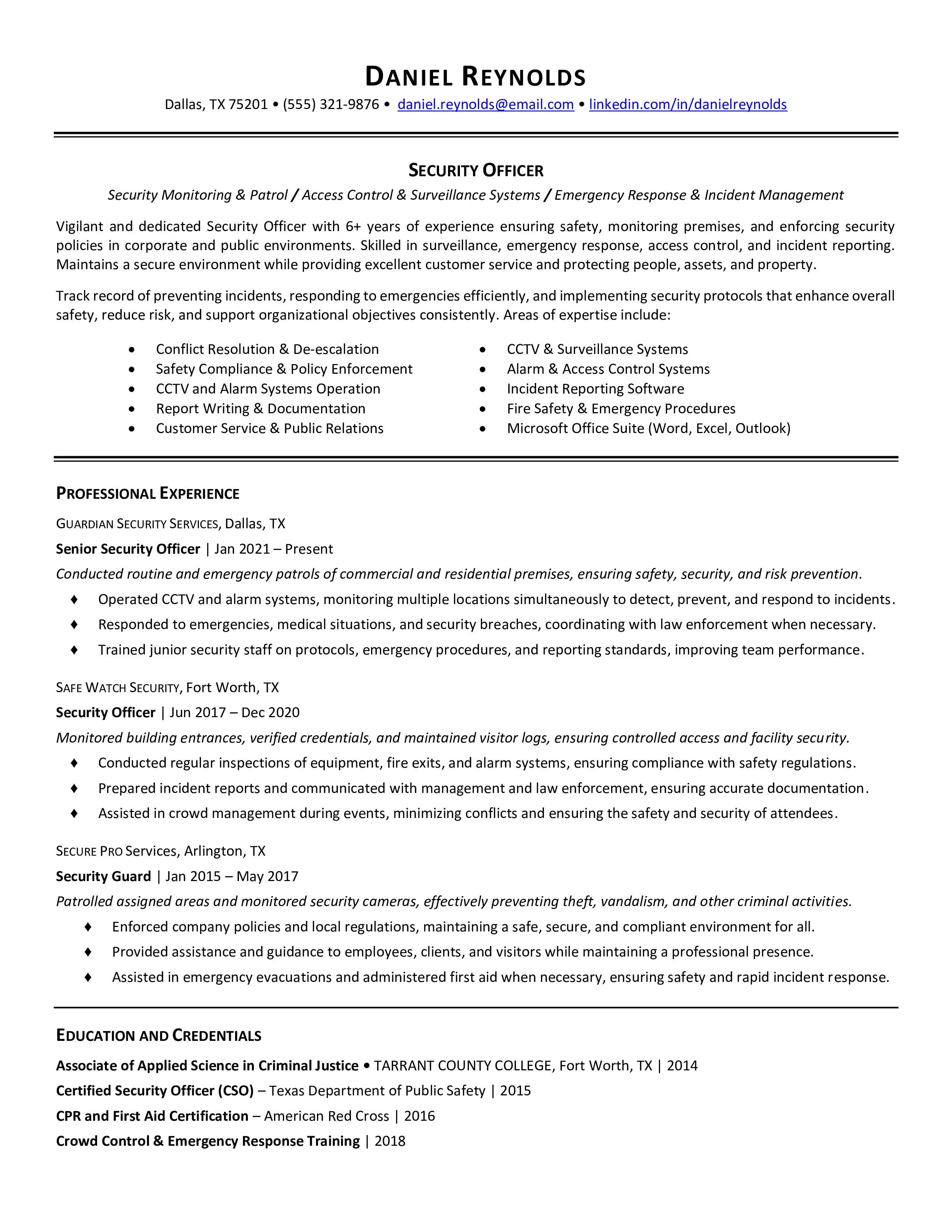





Create your security officer resume
Join the high-demand security services industry that provides protection and peace of mind to individuals and businesses. Create an effective security officer resume today.
What is a security officer?
Essentially, a security officer oversees security-related services and activities within a facility or group and is the main point of contact for such services. Their role is to keep the area or facility safe and secure for its occupants, whether they are residents, employees, staff, or visitors. For security officers assigned to specific individuals, their primary objective is to keep these people safe and secure.
The security officer is granted authority by the company or organization they represent to prevent, stop, or respond to unlawful acts occurring in their presence. An effective security officer has the proper training and skills to perform these duties in adherence to the relevant policies and procedures of the company or organization.
A significant number of security officers are former military personnel who transition into civilian employment, applying their operational experience and training to private or corporate security environments.
The functions of security officers vary depending on the environment in which they work. They generally do the following tasks:
- Ensure the safety of the people, property, and assets
- Respond to emergency situations and untoward incidents
- Control and monitor access
- Conduct inspections and patrol the area
- Write incident reports
- Maintain visibility to deter crime
- Enforce security measures, drills, and training
What is a security officer's resume?
A security officer's resume is a summary of their professional background and skills, educational achievements, and training. It is designed to present their strengths as a security worker and to showcase industry-specific knowledge. It must highlight the security worker’s broad work experience, ability to adapt to different environments, and capacity to work efficiently under pressure.
A resume specifically designed for the security officer position is your first chance to impress hiring managers looking to fill related roles. Being familiar with what employers look for will help you identify relevant qualifications you can include in your resume. Check out the tips and resume writing guide in the next section.
Creating your security officer resume
Compile and organize your details Gather all relevant professional information and review the job description closely to understand the employer’s expectations. Tailoring your resume to each opportunity helps highlight the skills and experience most applicable to the position. Having your information organized in advance allows you to present your qualifications in a clear, focused, and strategic way.
What to prepare:
- Names of past employers and employment timelines
- Key accomplishments and quantifiable outcomes in each role
- Professional credentials and educational/training background
- Core responsibilities and extent of job duties
- Relevant skills and competencies
- Performance metrics
Select the most suitable resume layout Choosing the appropriate resume format is essential, as each style highlights different aspects of your professional background and career stage. Understanding how each format works allows you to present your qualifications in the most effective way.
- Reverse-chronological format – Ideal for security officers with consistent work experience. This layout lists positions, starting with the most recent role and works backward, clearly showcasing career development and continuity.
- Functional format – Best suited for recent graduates or security workers transitioning into the industry or a new field. This format focuses on skills and professional competencies rather than emphasizing employment history.
- Combination format – Best used by experienced security personnel. This approach integrates key skills with work experience to deliver a balanced overview of both capabilities and career history.
Structure your resume Don’t just rely on ChatGPT for resume writing. Build your resume using a clear, effective framework that highlights your qualifications and strengths. The structure outlined in the following section offers practical guidance to help you produce a strong, engaging resume that meets employer expectations. A well-formatted resume allows hiring managers to evaluate your experience and fit for the position quickly.
Standard sections in a security officer resume are:
- Contact information or header
- Professional summary or objective
- Employment history
- Key skills and competencies
- Licenses and certifications
- Honors, awards, or notable achievements, if applicable
Contact Information
Your contact information, also known as the header, is a required section of your resume. It must be the top part of your document or in a prominent spot where recruiters can easily see it, such as the top part of your sidebar. The contact information section contains all relevant details where you can be reached.
Provide the following information in your contact details:
- Full name – official name as it appears on your professional or legal records
- Phone number – preferably a current mobile number you use and access regularly
- Email address – a professional email address, ideally one that includes your name
- Location – city and state, if needed
- LinkedIn profile or professional website – an updated LinkedIn profile or portfolio that supports your resume
Professional summary
Write a concise professional summary of two to three sentences that outlines your security background, career focus, and interest in the position. This section should quickly communicate your level of experience as a security officer; key skills such as surveillance, access control, or incident response; relevant certifications or training; and any notable accomplishments.
For entry-level or newly licensed security officers, consider using a Career Objective in place of a Professional Summary. An objective highlights skills gained through training or education and connects them to your professional goals in the security field. Including descriptors that reflect reliability, vigilance, and professionalism can help employers recognize your potential, work ethic, and commitment to growth early in your career.
Work experience
This section presents your employment history and professional growth and is one of the most important parts of a security officer resume—particularly for candidates with hands- on experience in security or law enforcement environments. It often takes up the largest portion of the resume and allows employers to understand how your responsibilities, skills, and situational judgment have developed across different posts and facilities.
Include all experiences that contributed to your development as a security professional, such as full-time or part-time positions, contract assignments, internships, volunteer roles, or relevant training deployments.
List each position using concise bullet points that clearly describe your duties and contributions. Follow this format for consistency:
- Job Title | Employment Dates
- Company or Organization | City, State
- Action-oriented responsibility, purpose, and measurable outcome
Start each bullet point with strong words to describe yourselfand your duties, followed by a brief explanation of the task performed, its objective, and the result achieved whenever possible. Use this structure consistently across all security-related roles to create a clear, results-focused presentation.
To keep your resume clear and impactful, aim for about five bullet points for your current or most recent position and three bullet points for earlier roles. Customize this section to align with the job posting by emphasizing relevant security functions such as access control, patrol operations, incident reporting, or emergency response. As you gain additional experience, update your resume regularly to reflect your growth and distinguish yourself from less experienced candidates.
Security officers work in a wide range of settings, including corporate offices, gaming facilities, residential communities, and industrial sites, each with unique responsibilities. It is in your best interest to research the position and company you’re eyeing, so that you can better understand their expectations if you get hired. You may also learn more about the duties of each role and the salary range to help you make a more strategic decision about your job application.
The following responsibilities illustrate security work experience that varies according to role, work environment, and experience level. These are examples you may consider for your resume content.
COMMON SECURITY PERSONNEL ROLES & RESPONSIBILITIES
Screener
- Performs phlebotomy and specimen collection
- Conducts basic lab tests and maintains lab equipment
Urgent care and emergency clinical medical assistant
- Responsible for monitoring and examining airline passengers to maintain safety and security standards
- Verifies travelers’ compliance with baggage and item restrictions before boarding
- Uses specialized equipment, such as metal detectors, handheld scanners, and screening tools, to inspect passengers and carry-on items
- Secures items identified as prohibited or hazardous materials and refers passengers for additional screening or investigation
Security guard
- Responsible for safeguarding property, assets, and individuals from potential risks and security threats
- Monitors and patrols assigned areas and grounds
- Operates surveillance systems and equipment to identify suspicious activity
- Inspects buildings and entry points to ensure the security of premises
- Controls access to facilities and properties, and responds to alarms
- Implements preventive measures to reduce theft, damage, or other losses
Surveillance officer
- Responsible for guarding people and property
- Identifies and responds to unlawful activity
- Conducts regular patrols of assigned locations
- Observes individuals showing unusual or suspicious behavior
- Conducts security inspections, documenting incidents and observations in a detailed report
- Monitors alarm systems and surveillance footage
Patrol officer
- Responsible for maintaining order in a community
- Enforces laws and local regulations
- Patrols areas to ensure the safety of the community and citizens
- May investigate crime or work with crime investigators
- Directs traffic
Security escort
- Responsible for safeguarding individuals or small groups during transit and on-site movements
- Ensures safe travel and secure arrival at designated locations
- Accompanies authorized visitors or non-cleared personnel within controlled worksites
- Maintains security protocols and ensures that restricted areas remain protected
Security officer
- Performs functions similar to those of security guards, but with greater autonomy and broader responsibilities
- Patrols assigned areas, which may include overseeing the work of security guards
- Makes independent decisions when responding to incidents
- Serves as a point of coordination between internal departments, emergency responders, and external agencies
Security manager
- Is involved more with overall department supervision than day-to-day hands-on operations
- Establishes security policies and procedures
- Sets a budget for security operations
- Recruits and trains security officers and security guards
- Tracks the security department's success regularly, identifying improvement opportunities
Security specialist
- Responsible for matters related to a building or facility’s security system
- Ensures proper operation of security network and employee identification card systems
- Resolves security system issues
- Trains employees on the use of security system components and devices
Security engineer
- Responsible for evaluating and validating security software and tools
- Supervises network and system activity for potential threats and breaches
- Detects and prevents breaches or unauthorized entry
- Advises management on enhancements and strategies to strengthen overall security systems and infrastructure
Security analyst
- Responsible for safeguarding an organization’s digital resources and information systems
- Focuses on maintaining secure networks and preventing unauthorized access to sensitive data
- Conducts security evaluations
- Investigates system breaches
- Carries out both internal and external audits
- Develops training initiatives to educate employees on cybersecurity policies and best practices
Security consultant
- Evaluates existing security measures to identify vulnerabilities and potential risks
- Recommends strategies and solutions to improve protection and prevent breaches
- May work exclusively with a single organization
- May offer advisory services to multiple businesses facing security challenges
SPECIAL SECURITY OFFICER DESCRIPTIONS BASED ON WORK ENVIRONMENT
While common security personnel responsibilities may be similar to each other, actual tasks may vary depending on your workplace or organization. Below are examples of accomplishments by security officers in different work environments.
Campus safety officer
- Responded to more than 100 emergency calls and medical events
- Led monthly dormitory safety checks, reducing threats by 25%
- Assisted students in crisis together with the campus counseling team
Correctional security officer
- Supervised activities in living quarters and recreational areas for over 500 inmates
- Helped with emergency lockdowns and unannounced searches, ensuring compliance with protocols
- Achieved zero disciplinary writeups in over 2 years
Residential security officer
- Monitored the entrance of a residential complex with more than 100 residents
- Managed access logs for vehicles and visitors
- Made nightly patrols and responded to safety concerns by residents, reducing complaints by 50%
Hospital security officer
- Patrolled emergency rooms and other hospital areas, responding to an average of 20 incidents per month
- Assisted nurses and hospital staff in managing restless patients
- Worked with local police regarding on-site incidents and concerns
Event security specialist
- Conducted perimeter checks and crowd control activities during entry and exit
- Managed a team of 10 security officers at concerts with more than 4,000 attendees
- Implemented a proactive patrol strategy that resulted in 40% lower disputes
Bank security guard
- Managed unlocking activities in the morning and closing in the evening for the branch’s main office and ATM areas
- Managed vault room access logs, ensuring compliance with process protocols
- Filed incident reports
Hotel security officer
- Handled 250+ guest-related incidents and complaints, achieving a 90% satisfaction rate
- Worked with front desk personnel to improve guest check-in security procedures
- Implemented proactive corridor inspections, reducing night noise complaints by 50%
Retail security specialist
- Apprehended 50+ shoplifters, working with law enforcement for proper processing
- Conducted active floor patrols and employee safety briefings
- Performed daily audits on high-value merchandise displays and backroom access
Loss prevention associate
- Conducted over 200 internal investigations, which led to the successful resolution of 85% of the cases
- Performed proactive monitoring and team training, resulting in 15% lower incidents of store theft
- Trained more than 20 new loss prevention associates in theft prevention and security policies
Night security officer
- Conducted foot and vehicle patrols across 10 buildings every hour, reducing incident reports by 20%
- Responded to more than 10 fire alarm activations, addressing them with full adherence to protocols
- Managed overnight access requests from building occupants, improving the satisfaction rating of after-hours support by 10%
Skills
This is a critical section of your resume, as your skills may determine whether an employer reviews your application closely or moves on. This area should highlight the competencies and strengths that support your success in the field. It should clearly reflect your ability to use relevant tools, implement procedures, and exhibit knowledge of policies and laws, among other things. Include technical proficiencies, equipment and system handling, specialized techniques, and key soft skills that enhance your overall effectiveness.
Below are examples of security officer skills:
HARD SKILLS
- Patrol procedures
- Emergency response protocols
- Controlled substance handling (DEA regulations)
- Basic security and fire inspection
- Physical combat training
- First aid and CPR
- Federal and state security regulations
- CCTV and surveillance system operation
- Access control cards and systems
- Monitoring software and alarms
- Incident report preparation
- Evidence collection and documentation
- Conflict de-escalation techniques
- Cybersecurity awareness
SOFT SKILLS
- Keen observation
- Communication
- Physical fitness
- Honesty
- Attention to detail
- Teamwork & collaboration
- Adaptability
- Problem-solving
- Critical thinking
- Integrity
- Professionalism
- Customer service
- Time management
- Leadership
- Multitasking
Customizing this section to reflect your level of experience and area of responsibility can help distinguish you from other security officer candidates. Strengthen your profile by adding context (especially when it comes to the soft skills)—highlight real-world situations where you effectively applied your skills to maintain safety, enforce policies, or respond to incidents.
Best practices for presenting security officer skills:
- Use clear bullet points for easy scanning and quick comprehension.
- Focus on skills most relevant to the security role you are applying for.
- Align your skills with the specific duties and qualifications listed in the job posting.
- Include job-related keywords to improve compatibility with applicant tracking systems (ATS).
Education and training
Education and training, as well as certifications and licenses, are essential components of a security officer’s resume. They demonstrate professional training, regulatory compliance, and a commitment to ongoing development. Employers use this information to evaluate your preparedness, situational awareness, and ability to perform security duties effectively while maintaining safety and order.
Most states basically require security personnel to be at least 18 years old (for unarmed posts) or 21 years old (for armed posts). A high school diploma or GED is a standard requirement. If you have other security-related educational achievements, include all in this section. Many employers may require drug screening and documents showing U.S. work eligibility; you can include them here.
Mandatory training requirements often include:
- Observation
- Legal basics
- Report writing
- Emergency response
- De-escalation techniques
- Situational awareness
- Access control procedures
- Emergency communications
For armed security roles, typical training requirements include:
- Firearms safety course
- Safe carrying drills
- Holster retention levels
- Loading/unloading drills
- Malfunction drills
- Judgment training
- Ammunition and duty gear standards
- In-house policy training
Present your educational background in this manner:
- List your highest degree, field of study, and institution in bullets or a clear, concise format.
- Recent graduates may include a graduation year along with relevant coursework or training.
- If you’re an experienced security officer, emphasize advanced degrees or specialized training.
- If you are moving from another specialty to security, highlight education or certifications that support the transition.
Licenses and certifications
Licenses are state-based. Most states require registration or a guard card. In California, for instance, the state requires BSIS (Bureau of Security and Investigative Services) registration, together with the required hours (more than 6 months) of training. New York’s Department of State requires training for armed and unarmed guards. Mention all your training programs in your resume. Licenses don’t usually cross states, so if you are applying for a job in another state, make sure you take their licensing program and mention your license in that state.
Certifications include the following:
- Physical Security Certification (PSC)
- Armed Security Guard license
- Commercial Driver License (CDL)
- OSHA Safety Certificate – to show awareness of workplace hazards and safe work practices
- Adult and Pediatric First Aid/CPR/AED
- Transportation Worker Identification Credential – for posts in maritime and port environments
- FEMA’s ICS-100/200 – for emergency response and incident management
- CPI (Crisis Prevention Institute) – for hospital security environments
- MOAB (Management of Aggressive Behavior) – for hospital security environments
- NIMS – for corporate security environments
When writing your security officer resume, include the certification or license name, the organization or agency that issued it, and the date the certification was obtained.
Some helpful recommendations:
- Keep your security officer resume to one page for candidates with fewer than 10 years of experience. For candidates with more extensive experience, a two-page resume can be created, but only if past positions are vital to the job application.
- Choose clean, non-intricate fonts that are scannable by applicant tracking systems (ATS) and easily readable by recruiters.
- Save and submit your resume as a PDF file to preserve the formatting and to easily share, view, and print the file across devices.
Boost your career with a security officer resume from Resumeble
Stand out in the competitive security industry with a professionally written resume. Choose one of our curated resume packages and let our expert writers craft a powerful security officer resume that highlights your skills, experience, and reliability.