 Published: 01 Jun 2026 | 11 min read
 Summarize in ChatGPT
Staying competitive in these fields also means keeping up with resume trends and ensuring your qualifications are presented in a way that highlights your expertise and adaptability. For those pursuing these competitive and demanding roles, presenting your qualifications effectively is crucial, which is where resume writing services can be invaluable.
In this exploration, we dive into what makes these roles the world's top 10 most challenging jobs and why they are respected and revered by many.
15 most difficult jobs in the world
The hardest professions in the world are also some of the most competitive careers in the US. They often demand an extraordinary level of physical and mental endurance, often requiring extensive training and unwavering commitment. These qualities are not only essential for success in these roles but also highly transferable for military veterans transitioning into civilian careers or those seeking employment in federal sectors. For individuals in these situations, specialized services like military and federal resume writing can help effectively highlight these unique skills and experiences.
Here is our top 15 list.
1. Alaskan crab fisherman
Average salary: $50,000-$100,000 in a three-month crabbing season
The Bering Sea does not care about your experience. Alaskan crab fishermen work in conditions that would shut down most other industries - sleep deprivation, wave heights over 30 feet, and temperatures cold enough to make a wet deck actively dangerous. The work is also seasonal and unpredictable; a bad season means a bad year. That said, a strong season for an experienced deckhand can still bring in up to $100,000 in three months, and senior crew members on successful boats have reported six-figure seasons. The fatality rate for fishing workers is roughly 70 times the national average for all occupations, according to the Bureau of Labor Statistics.
2. Airline pilot
Average salary: $203,000
While it might seem glamorous to fly the skies, airline pilots contend with enormous responsibility. Ensuring the safety of hundreds of passengers and navigating varying weather conditions places pilots under immense pressure. They must also maintain a calm demeanor during unforeseen events, which makes this role one of the most challenging jobs in the world. Consider researching the best airlines to work for if you are thinking about a career change.
What the job doesn't advertise: pilots are dealing with increasingly unpredictable weather patterns, staffing shortages that have led to chronic fatigue issues at regional carriers, and the mental health reporting stigma that still keeps many from seeking the help they need. The FAA requires pilots to report certain mental health conditions, which discourages disclosure. There's a real conversation happening in aviation right now about whether that tradeoff is making flying safer or less safe.
3. Air traffic controller
Average salary: $137,000
ATC is one of those jobs that sounds manageable until you're doing it. Controllers typically handle dozens of aircraft simultaneously, communicating in precise language under time pressure that leaves almost no margin for error. The FAA mandates retirement at age 56, which tells you something about the cumulative toll. Burnout and high turnover at understaffed facilities have been a documented problem in recent years - the FAA was short roughly 3,000 controllers as of 2024, meaning the remaining workforce was absorbing extra load.
4. Commercial diver
Average salary is $34,778 / Maximum salary of $300,000+
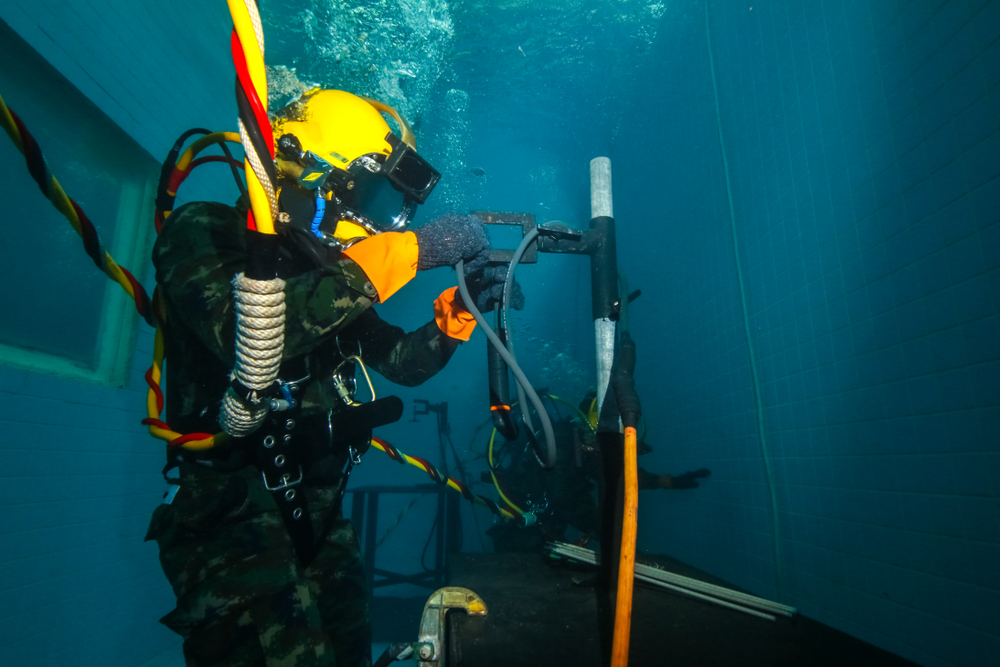
Commercial divers often perform repairs and inspections in cold, dark, and potentially hazardous deep waters. The physical demands and risks associated with underwater pressure, limited visibility, and the isolation of the deep sea rank this as one of the hardest professions in the world. However, it can also be a thrilling career for those with a passion for underwater exploration and problem-solving. Don't get discouraged by the median salary this profession boasts: highly experienced commercial divers, especially those involved in saturation diving or working in the offshore oil and gas industry, can earn upwards of $180,000 to $300,000 per year. Saturation divers, who work at extreme depths for extended periods, are among the highest-paid, sometimes making over $1,000 per day plus bonuses.
5. Explosive ordnance disposal specialist
Average salary: $47,567 / Maximum salary: $150,000
Handling explosive devices that could detonate at any moment is unquestionably one of the most stressful roles one can undertake. Explosive ordnance disposal specialists require nerves of steel and a steady hand to deactivate or dispose of hazardous ordnance, often putting their lives at risk to save others. Advanced training, certifications, and critical skills are needed to progress in this career. Senior EOD specialists in the military, such as Master Sergeant or higher, can count on potentially earning up to $80,000 or more, while civilian EOD specialists can look at averages of $50,000-$90,000 and maximums of $100,000-$150,000 a year.
6. Trauma surgeon
Average salary: $409,665

Trauma surgeons operate on patients who are actively dying. There is no scheduled appointment, no controlled intake process, and no guarantee the person on the table will still be alive by the time the procedure is done. A single shift can involve a car accident victim, a gunshot wound, and a pediatric emergency, back to back, with the same level of precision required for all three. The training pipeline is one of the longest in medicine: four years of medical school, five years of general surgery residency, and a fellowship on top of that. By the time a trauma surgeon is working independently, they have spent the better part of a decade learning how to make the right call in seconds. Burnout rates in the specialty are high, and the hours don't ease up with seniority.
7. Correctional officer
Average salary: $51,410
Correctional officers are responsible for managing people who, in many cases, have nothing left to lose. They work in facilities that are chronically understaffed, where a bad day can turn dangerous with almost no warning. Assault rates in prisons and jails are significantly higher than in most other workplaces, and the psychological toll of spending eight to twelve hours a day in that environment is well documented. Studies have found that correctional officers have above-average rates of PTSD, depression, and suicide compared to the general working population. The salary does not reflect the exposure. Most officers earn around $51,000 a year, and the job offers very little of the public recognition that goes to other first responder roles.
8. Nuclear plant operator
Average salary: $116,000
Nuclear plant operators control the systems that keep a reactor running safely, which means they are also the people standing between normal operations and something going very wrong. The training process takes years and involves both classroom instruction and simulator exercises that are deliberately designed to be stressful. Operators need to understand reactor physics, fluid dynamics, and emergency procedures well enough to respond correctly under pressure, in the middle of the night, after hours on shift. The industry's safety record is actually strong, but that record exists precisely because the people doing this job are held to standards that leave almost no room for error. The Chornobyl and Fukushima disasters are reminders of what the margin for error actually looks like when things go wrong.
9. Special forces operative
Average salary: $60,000-$90,000
Special Forces members undergo some of the most rigorous training regimens to perform in hostile environments around the world. These elite professionals are trained to execute missions that require exceptional physical fitness, unshakable mental endurance, and unparalleled emotional resilience. From surviving extreme climates to maintaining composure under life-threatening conditions, their preparation pushes human limits. This level of dedication and performance exemplifies why their role is widely regarded as the hardest profession in the world. For civilians aiming to excel in their careers, accessing tools like the best resume builders can help showcase their unique skills and determination, though few challenges compare to those faced by these extraordinary individuals.
10. High-altitude mountain guide (Everest Sherpa)
Average salary: $5,000–$10,000 per season

Sherpa guides make Everest expeditions possible for the climbers who hire them, which means they carry the heaviest loads, fix the ropes on the most dangerous sections, and often make multiple summit rotations in a single season while their clients make one. The mortality statistics are stark: Sherpas die on Everest at a rate that would shut down any regulated industry in the developed world. The 2014 Khumbu Icefall avalanche killed 16 Sherpa guides in a single event. Many continue because the pay, modest by Western standards, is transformative in the context of rural Nepal, where alternative income is scarce. It is one of the clearest examples anywhere of a job where the people taking the most risk are not the ones receiving the most reward.
11. Wildfire firefighter (Hotshot crew)
Average salary: $40,000-$60,000
Hotshot crews are the people sent to the front line of wildfires on foot, with hand tools, cutting firebreaks in terrain that's actively burning around them. They work 16-hour shifts for weeks at a time during fire season, sleep in the field, and operate in smoke and heat that would ground most other emergency response teams. Climate change has extended the fire season significantly; in parts of California and the American West, there's now barely an off-season. Pay starts around $35,000-$45,000 for entry-level positions, which is one of the more glaring mismatches between compensation and risk in any profession.
12. Long-haul truck driver
Average salary: $57,440

Long-haul trucking doesn't look dangerous from the outside, which is part of why its toll is underappreciated. Drivers log up to 11 hours a day behind the wheel, often on broken sleep schedules that research has consistently shown impair judgment comparably to alcohol. The profession has one of the highest rates of musculoskeletal injuries and cardiovascular disease of any occupation. Truckers also work largely alone, which creates mental health challenges that the industry has been slow to address. According to the BLS, heavy and tractor-trailer truck drivers face a fatality rate roughly 7 times the national average.
13. Psychiatric nurse
Average salary: $65,000-$100,000
Psychiatric nurses work with patients in acute mental health crises, including those experiencing psychosis, severe suicidal ideation, or violent episodes. The emotional labor of this role is difficult to overstate: nurses build therapeutic relationships with patients in extreme distress, often over long periods, then have to maintain professional boundaries while managing personal grief when things go badly. Workplace violence is a documented and underreported problem in psychiatric settings - a study in the American Journal of Nursing found that assault rates in inpatient psychiatric units are significantly higher than in other hospital settings.
14. High-altitude construction worker / Wind turbine technician
Average salary: $62,580
Wind turbine technicians climb towers 200 to 300 feet in the air, often in weather that would delay any other outdoor work. Once up there, they perform maintenance on complex mechanical systems in a workspace roughly the size of a small closet, with the whole structure moving beneath them. The Bureau of Labor Statistics projects strong job growth for this role through 2030, which sounds like good news until you factor in that the industry is still developing standardized safety protocols and that many technicians work in remote locations far from emergency services. It's physically demanding, technically complex, and genuinely not for anyone who hesitates about heights.
15. Offshore oil rig worker
Average salary: $50,000–$100,000 | Senior roles: $120,000–$200,000+
An oil rig is a small industrial city floating in open water, and someone has to keep it running around the clock. Workers operate heavy machinery around flammable materials, on rotating 12-hour shifts, weeks at a time, with no real way off if something goes wrong. The 2010 Deepwater Horizon explosion - which killed 11 workers and triggered the largest marine oil spill in US history - is the most visible reminder of the stakes. But the daily risks are more routine: equipment injuries, falls, fires, and fatigue from 84-hour weeks in total isolation. Entry-level positions start around $40,000–$60,000, but experienced drillers and toolpushers can clear six figures, and senior rig managers often earn well over $200,000. The pay reflects what you're trading away to earn it.
Are you prepared to take on the hardest jobs in the world?
What connects all of these roles is that none of them can be automated away easily, and most of them are invisible to people who don't do them. The saturation diver working 300 feet underwater, the hotshot crew cutting a firebreak at 3 a.m., the psychiatric nurse managing a ward through an understaffed night shift - these are people doing things that most of us couldn't or wouldn't. The thing to keep in mind is that, though hard, they are, for the most part, future-proof, meaning that while robotization and AI will enhance them by providing better accuracy, diagnostics, and safety, they will not replace them. These demanding professions require critical thinking, complex decision-making, creativity, and human empathy and are likely to evolve into the jobs of the future rather than becoming obsolete. This stands in contrast to specific jobs that will be gone by 2030 due to automation, as these physically and mentally intensive careers continue to thrive.
If you're moving into one of these fields or transitioning out of one, the challenge of communicating what you've done on a resume is real. The skills these jobs require (think high-stakes decision-making, physical and mental endurance, technical precision under pressure, etc.) don't always translate neatly to a standard resume format. That's where a professional resume writer who understands demanding, specialized careers can make a real difference.