
Create a medical assistant resume guide
According to the US Bureau of Labor Statistics,medical assistant employment is expected to grow by 12% from 2024 to 2034, which is faster than most other occupations. An average of about 112,300 openings for medical assistants is projected each year during this period. Retirement and employee transfers to other industries and fields are the main reasons cited, but the healthcare sector is generally expanding due to higher demand from aging patients and those with chronic illnesses.
Given this outlook, the medical assistant workforce is not downsizing any time soon. If you’re keen on joining and thriving in this sector, it’s essential to build a medical assistant resume that showcases your capabilities and truly stands out from the competition.
Learn how to create a medical assistant resume that will attract employers’ attention and get you the role you want in the healthcare industry. Check out Resumeble’s medical assistant resume writing guide below or download a free resume sample.
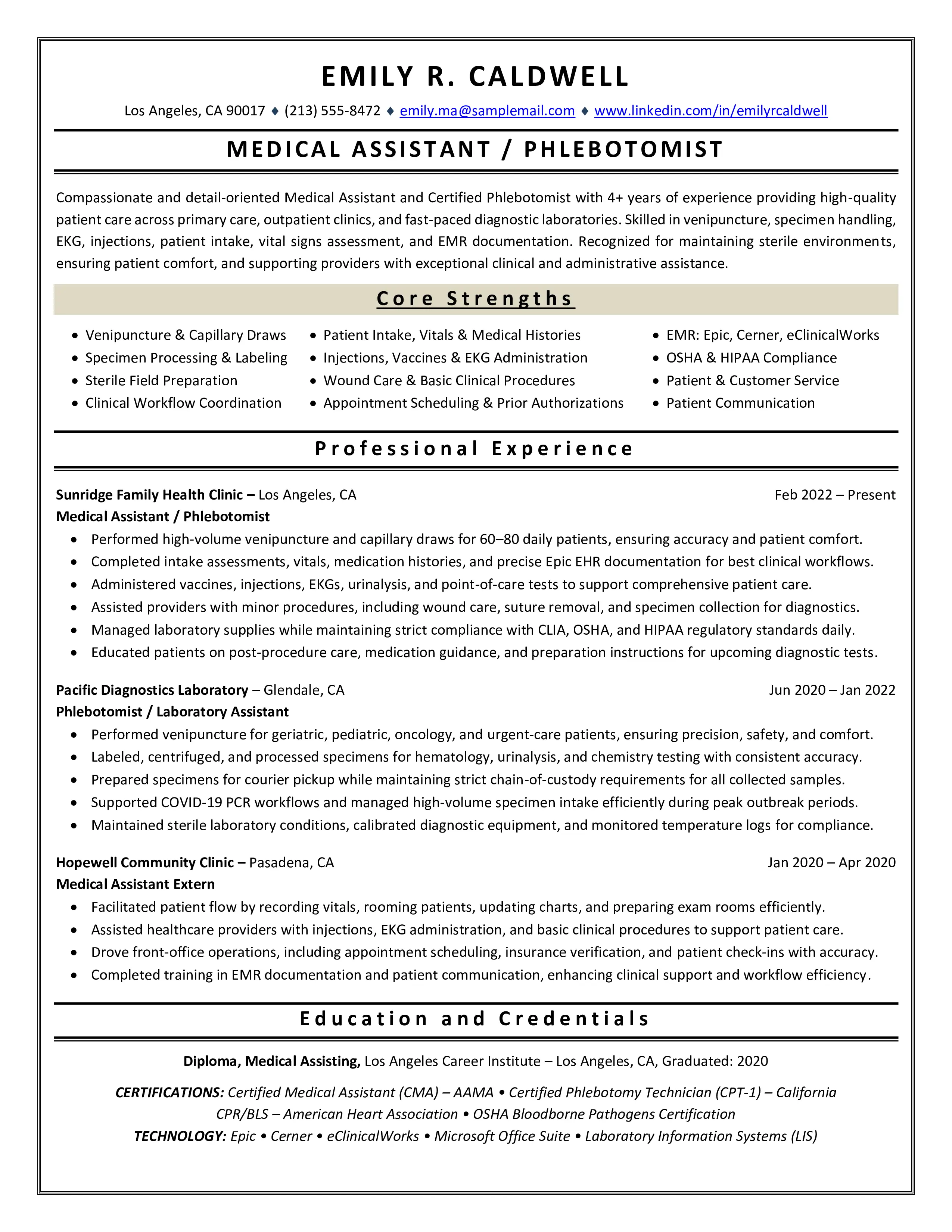





Create your medical assistant resume
Join thousands of medical assistants who keep the healthcare industry and medical practices efficient. Create your medical assistant resume today!
What is a medical assistant?
A medical assistant (MA) refers to any individual performing clinical or administrative tasks in a healthcare setting, including hospitals, outpatient centers, doctors’ offices, and urgent care clinics. They may be assigned to specific offices or departments or function as part of a pool that assists physicians. Some MAs have specializations, enabling them to work better with their patients.
Doctors rely heavily on medical assistants for efficient operations and procedures. Medical assistants perform the following tasks, among others:
- Manage scheduling
- Preparing patients
- Updating records
- Taking vital signs
- Helping with tests
- Drawing blood
- Administering injections
- Managing billing or insurance paperwork
Medical assistants are divided into those who handle clinical and administrative duties. Some MAs can do both, which is valuable for the hospital or clinic.
Clinical medical assistants in primary care clinics typically assist with patient procedures, taking vital signs, and checking medical histories. They also help physicians conduct routine exams and preventive care visits. MAs in specialty clinics perform tasks and procedures based on the doctor’s field.
Administrative medical assistants perform the non-clinical aspects of healthcare. These include manning the doctor’s office, checking patient schedules, organizing records, managing office correspondence, and performing clerical work.
What is a medical assistant resume?
A medical assistant's resume contains details of their work experience, skills, education, licenses and certifications, training, and other relevant information about their career progression as a healthcare worker. Since they often function as the jack-of-all-trades of the medical industry, they are expected to be proficient in handling both clinical and administrative tasks. These capabilities must be seen on the resume.
The goal of a medical assistant resume is to demonstrate to prospective employers that you are a strong fit for their job opening. Crafting a resume that highlights your skills and specializations is important. The next section provides a medical assistant resume format template and outline for writing. Read on to learn more about it.
Create your medical assistant resume
- Prepare the information you need. Before drafting your resume, ensure all relevant information is organized and aligned with the specific job posting. Tailor your resume to reflect the requirements of each role. Preparing targeted information in advance allows you to highlight qualifications that are most relevant to the position.
Examples of information to gather:- Names of previous employers and dates of employment
- Key accomplishments and measurable outcomes in each role
- Relevant licenses and certifications
- Scope and type of responsibilities performed
- Average patient load or caseload managed
- Efficiency metrics or performance indicators, where applicable
- Number of staff or team members you worked with
- Data related to clinical specialties or areas of expertise
- Select an appropriate resume format. Choosing the right resume format is essential, as each format is designed to highlight different career stages and professional strengths. The three best resume formats online are:
- Reverse-chronological format - This format is best suited for medical assistants with consistent and extensive work experience. It emphasizes career progression by listing roles in reverse order, showcasing growth within the same or closely related specialties.
- Functional format - Ideal for new medical assistant graduates or those transitioning into a new specialty, this format focuses on skills and competencies rather than a detailed employment timeline.
- Combination (hybrid) format - Well-suited for mid-career MAs, the combination format balances both skills and professional experience, providing a comprehensive overview of clinical or administrative expertise and work history.
- Write your resume. Begin crafting your resume by following a proven structure that emphasizes your qualifications. The outline below provides key tips to help you create a compelling, attention-grabbing resume that aligns with employer expectations. With a well-organized resume, hiring managers can assess your value and suitability for the role immediately. The common sections of a medical assistant resume include:
- Header
- Professional summary
- Work experience
- Skills
- Certifications and licenses
- Awards, recognitions, achievements, if any
Header
Regardless of the overall design, your resume header should clearly and consistently present your contact information. If your resume captures a recruiter’s interest, the header is typically the first section reviewed to determine how to reach you. For maximum visibility, place your contact details in a prominent location, such as at the top of the page.
Include the following information:
- Full name – Use the name that appears on your professional or legal documents
- Medical assistant title – Clearly indicate your professional designation
- Phone number – Provide a regularly monitored number; avoid unattended phones
- Email address – Use a professional email address, ideally incorporating your name; avoid workplace emails or casual usernames
- Location – City and state are sufficient
- LinkedIn profile – A current and professional profile that serves as a credible reference for hiring managers
Professional summary
Create a concise two- to three-sentence professional summary that highlights your relevant experience and career direction and states why you are applying for the role. This section should include your years of experience as a medical assistant, key competencies, areas of specialization, certifications, and notable professional achievements. A well-crafted summary provides hiring managers with a clear snapshot of your qualifications.
For new medical assistant graduates, a career objective may be used in place of a professional summary. The objective should make a strong first impression by outlining the skills acquired through education or training and aligning them with your career goals.
Alternatively, use popular words to describe yourself and your values. This approach demonstrates professionalism, initiative, and a commitment to growth—qualities that are highly valued in aspiring medical assistants.
Work experience
This section often makes up the bulk of the resume's body. It expounds on the qualifications highlighted in your professional summary by detailing your most relevant professional experiences or any internship and volunteer opportunities that may qualify you for the position. List each medical assistant position in reverse chronological order, using concise bullet points to clearly present your experience.
Use the following format for each role:
- Job Title | Employment Dates
- Company or Organization | City, State
- Responsibility, purpose, and measurable outcome
Begin each bullet point with a strong verb, followed by the specific task performed, the objective or reason for the task, and the resulting outcome or quantifiable achievement. Apply this structure consistently to every medical assistant role listed.
Industry best practices recommend including five bullet points for your most recent position and three bullet points for previous roles to maintain clarity and relevance.
Tailor your resume to align with the job description and your area of specialization. If you have extensive experience in a particular clinical setting or specialty, ensure this expertise is clearly reflected. Update your resume regularly as you gain additional experience to differentiate yourself from entry-level medical assistants.
Below are examples of medical assistant tasks and general responsibilities according to their job title, to illustrate resume content appropriate for varying levels of expertise. Provide bullet points per job .
CLINICAL TASKS
Diagnostic and laboratory medical assistant (Phlebotomist)
- Performs phlebotomy and specimen collection
- Conducts basic lab tests and maintains lab equipment
Urgent care and emergency clinical medical assistant
- Works in fast-paced clinical environments
- Performs triage assistance, wound care, and emergency procedures
Geriatric and long-term care medical assistant
- Supports elderly patients with mobility, vitals, and chronic care management
- Assists with rehabilitation and daily living assessments
OB-Gyn and women’s health medical assistant
- Assists with prenatal exams and gynecological procedures
- Provides patient education and clinical support for women’s health
Specialty medical assistant
- Assists with specialized procedures and treatments
- Provides support for patients with specific conditions
Cardiology medical assistant
- Performs EKGs and cardiac stress test preparation
- Assists with cardiac monitoring and patient education
Orthopedic medical assistant
- Assists with casting, splinting, and mobility assessments
- Prepares patients for orthopedic procedures
Pediatric medical assistant
- Measures growth and development milestones
- Administers immunizations and supports child-focused care
Neurology medical assistant
- Assists with neurological exams and diagnostic testing
- Prepares patients for EEGs and nerve conduction studies
Dermatology medical assistant
- Assists with skin exams, biopsies, and minor procedures
- Prepares treatment rooms and manages dermatology instruments
Surgical medical assistant
- Prepares patients for minor surgical procedures
- Assists with sterile technique and post-procedure care
Ambulatory Surgery medical assistant
- Supports outpatient surgical procedures
- Assists with patient recovery and discharge education
ADMINISTRATIVE TASKS
Front office medical assistant
- Greets and checks in patients
- Manages appointment scheduling and patient flow
- Verifies insurance and collects co-payments
Medical receptionist/Administrative medical assistant
- Handles incoming calls and patient inquiries
- Schedules appointments and manages calendars
- Maintains patient records and office correspondence
Medical records & health information assistant
- Manages electronic health/medical records (EHR/EMR)
- Ensures accuracy, confidentiality, and compliance
- Processes record requests and releases of information
Medical billing and coding assistant
- Submits insurance claims and verifies coverage
- Assigns diagnostic and procedure codes (ICD, CPT, HCPCS)
- Follows up on denials and outstanding claims
Insurance verification and authorization assistant
- Confirms patient eligibility and benefits
- Obtains prior authorizations for procedures and services
- Communicates with insurance providers and clinical staff
Medical office administrator
- Oversees daily administrative operations
- Coordinates staffing schedules and office workflows
- Ensures compliance with healthcare regulations
Patient services coordinator
- Acts as liaison between patients, providers, and payers
- Manages referrals, follow-ups, and care coordination
- Ensures positive patient experience and continuity of care
Practice management assistant
- Supports physician practice operations
- Assists with reporting, scheduling optimization, and documentation
- Works closely with practice managers and administrators
OB-Gyn Administrative medical assistant
- Manages prenatal scheduling and patient documentation
Dental administrative assistant
- Handles dental records, billing, and patient intake
Behavioral health administrative assistant
- Manages confidential records and therapy scheduling
TASKS FOR SPECIALIZED PRACTICES
Aesthetic medical assistant
- Handles scheduling, billing, and payment
- Prepares patients for procedures
- Assists with or performs specific procedures
- Sterilizes rooms and medical supplies
Ophthalmologic medical assistant
- Prepares patients for medical exams
- Gets equipment ready for exams
- Administers basic eye test
- Teaches patients how to insert and remove contacts
- Instructs patients about tests, medications, and procedures
- Assists the doctor with ultrasound images
- Helps with in-office procedures
Endocrinology medical assistant
- Draws blood frequently
- Performs subcutaneous injections
- Administers medication
- Checks patients' blood sugar levels
- Collects urine samples
- Maintains accurate and up-to-date health records
Geriatrics medical assistant
- Assists physicians with physical assessments
- Checks measurements and vital signs
- Inspects the skin for anything abnormal
- Gives vaccinations and booster shots
- Helps patients navigate insurance
Family medicine medical assistant
- Creates new patient records
- Helps fill and refill prescriptions
- Removes stitches
- Gives medications
- Administers vaccinations
- Conducts child well-checks
- Draws blood
- Collects urine, saliva, and stool samples
Cardiology medical assistant
- Draws blood and sends it to the lab for interpretation
- Performs EKGs and informs the doctor of the results
- Assists with echocardiograms
- Refills prescriptions
- Schedules follow-up appointments
- Handles billing and insurance
Obstetrics/Gynecology medical assistant
- Takes weights, measurements, and vital signs
- Obtains health history
- Assists with exams and procedures
- Provides educational materials about reproductive and sexual health
Skills
Include both technical (hard) skills and interpersonal (soft) skills on your resume. Technical skills demonstrate proficiency in clinical procedures, equipment operation, and healthcare workflows. Interpersonal skills highlight personal attributes that support effective patient interactions, collaboration with healthcare professionals, and sound decision-making in complex or unexpected situations.
Below are some of the skills that medical assistants can include in their resumes:
HARD SKILLS
- Mastery of medical terminology
- Measurement of vital signs
- Knowledge of injections
- Cardiopulmonary resuscitation (CPR)
- Electrocardiogram operation (EKG)
- Phlebotomy
- Patient preparation
- Life support procedures
- Scheduling and appointment setting
- Handling of electronic medical/health records
- Medical coding
- Computer literacy
- Telephone skills
SOFT SKILLS
- Communication
- Teamwork
- Problem solving
- Empathy
- Multitasking
- Organization
Tailoring this section to your level of expertise and specialty will help you stand out from many other medical assistant applicants. Provide context for your skills by presenting real- life situations in previous jobs where these skills were most useful.
How to present your medical assistant skills:
- Write items in a bulleted list for easy scanning.
- Prioritize skills most relevant to the job offering.
- Adapt your skills and list to the job description.
- Use keywords that match the job posting.
Education and certifications
Your educational background is a critical component of your resume, alongside your professional experience. Employers seek clear insight into the level of education and training you have completed, as well as the institutions where you obtained them.
Medical assistants earn either an associate degree or a certificate accredited by the Commission on Accreditation of Allied Health Education Programs (CAAHEP) or the Accrediting Bureau of Health Education Schools (ABHES). These educational programs prepare you for the basic functions of medical assisting, as well as for mandatory certification requirements, such as the Certified Medical Assistant (CMA) by the American Association of Medical Assistants (AAMA). It is the most widely recognized certification for medical assistants.
Present your academic credentials in reverse chronological order, beginning with your most recent degree or certification program and progressing to earlier education. State where you earned the degree, the date you graduated, and academic awards or special citations, if any.
Medical assistants may earn other recognized certifications, including the Registered Medical Assistant (RMA), the National Certified Medical Assistant (NCMA), the Certified Clinical Medical Assistant (CCMA), and the Certified Medical Administrative Assistant (CMAM). Advanced and additional certifications widen your job prospects and chances for a pay increase. These certifications tell employers that you have skills other medical assistants might not possess.
When presenting your certifications, present the name of the certification, the organization that issued it, and the year you earned it. Begin with the highest or most advanced credentials.
Expand your career prospects in the healthcare industry with a compelling medical assistant resume. Let Resumeble's outline guide you, or check out our medical assistant resume examples for more ideas.
A few important pro tips:
- Your medical assistant resume should not be longer than two pages , even with extensive experience. Use your limited space by selecting the most relevant and important qualifications suitable for the role.
- Use simple and legible fonts for easy scanning by an applicant tracker system. While Arial and Times New Roman are ATS-friendly, they are overused. You might want to add a bit of personality to your resume.
- Two-column resumes are not a problem with ATS, contrary to some recent claims. If you're a long-time MA with extensive experience, you may use two-column resumes to maximize space.
- Export your document as a PDF. It's easier to print, scan, read, and send than other formats.
- Be mindful of your potential employer's location. Some countries, such as Canada, follow a different structure for their resumes.
Boost your career with a medical assistant resume from Resumeble
Be one of the most in-demand healthcare professionals today. Choose one of our curated resume packages and let our writers create a winning healthcare resume for you!