
Create a compelling aviation resume and join millions of aviation professionals today
The aviation industry is one of the most exciting industries to work in. Aviation provides travel opportunities for certain jobs, such as pilots and flight instructors. It also allows aviation degree holders to apply their technical skills, such as in aircraft mechanics and engineering.
As an exciting workplace, it is one of the most competitive. Boeing predicted that demand for new aviation workers will reach almost 2.4 million by 2044. Two-thirds of this volume will consist of replacements for retiring professionals. This is a positive development after the setback caused by the pandemic. It puts aviation back on the list of job market trends for 2025.
The outlook is rosy for aviation professionals. Take advantage of this growing demand to land the role of your dreams and a long-term employer. Discover how you can create an aviation resume that soars above the rest and brings your value to greater heights. Check out Resumeble’s aviation resume template writing guide here. See our list of resume outline tips and find a free sample.





Creating your aviation resume
Join millions of in-demand aviation professionals. Create the best aviation resume today!
Aviation jobs
Aviation jobs are any form of work that focuses on air travel, aircraft, or airport operations. They range from technical skills to safety and management roles. Working in aviation is possible by completing a degree in aviation or aeronautics. Courses include:
- Piloting
- Aircraft design
- Aviation safety
- Aircraft engineering
- Aviation law
- Aircraft maintenance
- Aerodynamics and physics
- Meteorology
You may take a two-year associate degree in aviation or a bachelor’s degree program. Bachelor’s degree programs last about four to six years and offer a deeper study of aeronautics, with the option to specialize in aviation safety, security, or airport management. Aviation degree holders may pursue careers as air traffic controllers, aircraft technicians, or aircraft mechanics.
Master’s degree programs take about two years to complete and prepare students for advanced careers in aeronautics. Jobs involving aircraft engineering, organizational leadership, and safety oversight may require a master’s degree. There’s also a doctorate in aviation, which offers specialized concentrations in airport development & management, safety, education & training, and operations. Those who earn this degree may pursue careers in aviation research or teaching.
What is an aviation resume?
An aviation resume details your experience in the aviation industry. It includes any work or position connected to aerospace, aircraft handling, or operations. Create an aviation resume when you’re applying for job titles like:
- Aerospace engineer
- Air traffic controller
- Aircraft mechanic
- Avionics equipment mechanic
- Electrical engineer
- Flight cabin crew
- Flight instructor
- Pilot
An aviation resume allows you to market yourself strategically to an employer. By demonstrating how your education, work experience, and skills contributed to a company’s success, you promote your value as a prospective hire. A well-written resume can easily put you on the shortlist of applicants who will move to the next stage of the process. It also shows your writing and communication skills.
Learn more about how to make your resume stand out in the next section.
Create your aviation resume
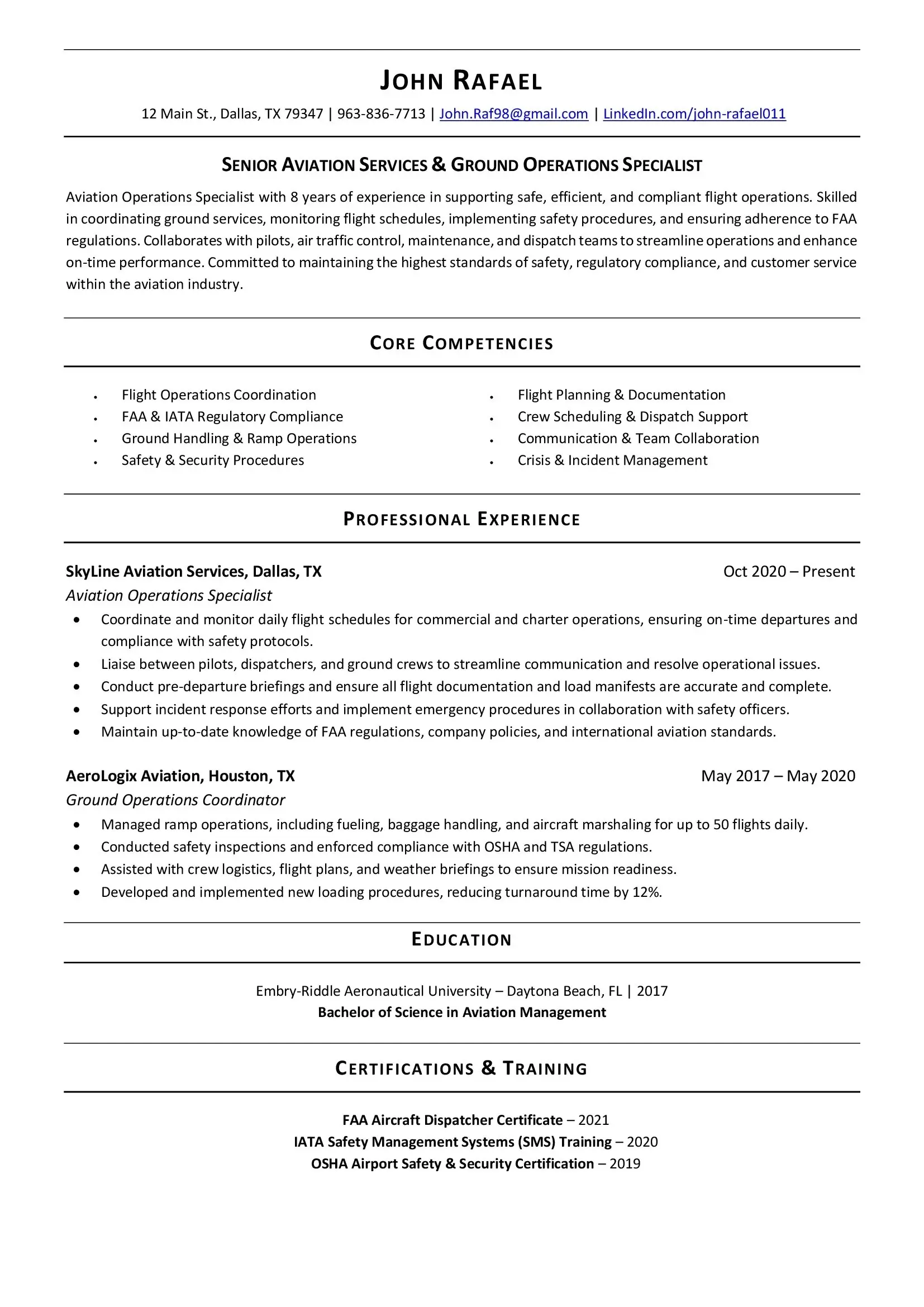
Before writing your resume, ensure you have all the necessary details. The regular resume structure includes your contact information, career objective, relevant skills, work experience, educational background, training, and certifications/licenses. An aviation resume must reflect both your technical and non-technical skills. Soft skills include customer service, communication, and leadership.
Choose your resume format. The most common is the reverse-chronological, which lays out your work history, from the most recent to the oldest. If you have been working for some time, this format lets recruiters see your professional journey. If you’re a new graduate, you can opt to highlight your skills instead of your work history. A functional format would be ideal, as it focuses more on your specialties and unique competencies.
Some choose the combination format, which is beneficial for workers switching industries or specializations. Learn how to format your resume strategically to attract the ideal employer.
Contact information
This section is the first thing recruiters see, so it needs to be placed at the top. Include the following when writing your header:
- Full name – Use the name that appears on your professional or legal documents. Hiring managers may check online profiles using the name you provided.
- Phone number – Share the number of a phone you frequently carry. If you can't always answer, set up a professional voicemail. Always use a standard international format to avoid confusion. Avoid a landline number that you don't have access to consistently.
- Email address – Provide a professional email address. One that reflects your name is ideal. If you already have an email, make sure it sounds professional. Avoid casual emails or quirky-sounding ones. Check your entry for accuracy to prevent bounced emails.
- Location – List only your city and state (or country, if the job in question is overseas). A full address isn't necessary for privacy reasons. Employers may use this information to determine if you're a local applicant or open to remote work.
- LinkedIn profile – Provide a link to your personal website or LinkedIn profile. Online profiles provide details of your career and skills that your resume can't fit. Recruiters may also find relevant recommendations from colleagues and former supervisors.
Career objective
This section, though considered redundant in many other industries, might prove valuable in Aviation; it shows your purpose for applying and your goals as an aviation professional. It consists of 2-4 sentences/phrases. Through your career objective, employers learn your long-term plans and how you wish to succeed in the role. Using the 3rd person POV can make this section sound more professional.
What to include:
- Professional goals or what you want to achieve
- How your goals match the role you are eyeing
- Skills and experiences that support the role
- Strengths as an aviation professional
- (Optional) mention certifications or licenses
Below are examples of aviation or pilot resume objectives:
- Detail-oriented individual pursuing a ground crew position to utilize my training in equipment handling, aircraft servicing, and passenger assistance while ensuring top-level safety and service standards.
- FAA-certified commercial pilot with 500 flight hours seeking a first officer position at Pacific Commercial Airlines, eager to apply my training and commitment to safety in supporting flight operations.
- Organized and proactive professional aiming for an aviation management role, leveraging expertise in regulatory compliance, team coordination, and operational efficiency to enhance airline performance.
- Dedicated and adaptable pilot eager to join Corporate Air Travel Company as a corporate pilot, bringing strong navigation skills, quick decision-making, and a focus on providing secure and efficient travel for clients.
Find more sample resume objectives here.
Skills
Experts recommend a skills section ahead of other resume contents to create a positive first impression. This section should underscore your competencies and areas of expertise that will contribute to your success in the industry. Highlight your skills in handling machinery, tools, and systems. Mention specializations, technical skills, and soft skills.
What aviation skills should you include?
Here are examples of technical aviation skills:
- Flight operations and navigation
- Aircraft systems knowledge (avionics, engines, hydraulics)
- Maintenance, inspection, and troubleshooting
- Safety protocols and emergency procedures
- FAA/EASA regulations and compliance
- Weather analysis and flight planning
- Aircraft performance monitoring
- Ground handling and ramp operations
- Maintenance, inspection, and troubleshooting
- Safety protocols and emergency procedures
- FAA/EASA regulations and compliance
- Weather analysis and flight planning
- Aircraft performance monitoring
- Ground handling and ramp operations
Examples of aviation operations and management skills:
- Air traffic control coordination
- Airport operations and logistics
- Crew resource management (CRM)
- Scheduling and dispatching
- Aviation security awareness
- Risk assessment and problem-solving
- Quality assurance and documentation
Examples of soft skills:
- Communication and teamwork
- Leadership and decision-making
- Customer service and passenger care
- Conflict resolution
- Cultural awareness
- Adaptability
- Conflict resolution
- Cultural awareness
- Adaptability
How should you present your aviation skills?
- Present a bulleted list of your skills.
- Prioritize the skills relevant to the role.
- Customize the skills section for different job applications.
- Use keywords in the job posting. This will help applicant tracking systems (ATS) recognize the relevance of your resume.
- Group your skills for easy reading.
- Make the skills section concise. Recruiters have limited time to scan documents.
Work experience
Place your work experience after the skills section. This section shows your professional journey and gives recruiters a complete picture of your career progress. If you have spent years in aviation, working in various environments and employers, this is a crucial chapter in your story.
How should you write your aviation experience?
Each job entry should state:
- Company/organization name and location
- Your job title
- Inclusive dates of employment
- Duties and responsibilities in each title
- Accomplishments
- Instances where you exceeded expectations
In writing your professional history, do the following:
- Use bullets. This makes your resume easy to scan. Six to eight bullets per job is ideal.
- Customize your entries based on the job posting.
- Start each description with action words to make your resume sound active.
- Provide context on how you solved problems or achieved positive outcomes.
- Be specific in your responsibilities and accomplishments. This helps hiring managers envision how your experience applies to the role.
- Quantify your accomplishments by using percentages, numbers, or measurable factors.
- Be selective in the jobs you include. You don't need to write all the roles; choose the ones that directly relate to the job posting.
- Include paid and unpaid jobs (such as internships), full-time and part-time jobs, and other work arrangements in aviation.
You may opt to present your work history according to your level of experience. Highlight the skills expected in relation to your status. Below are examples of various types of pilot jobs:
- Entry-level/mid-career/senior-level airline pilot
- Flight instructor/flight operations manager
- Commercial pilot
- Charter pilot
- Corporate pilot
- Student pilot
- Airforce pilot
- Drone pilot/drone operations manager
- Airline captain
Education & training
This section shows proof of your educational achievement and in-school or advanced training. List down your educational background in reverse chronological order. Having an aviation-related bachelor's degree is not mandatory to pursue a career in the industry. However, many employers prefer graduates of Aviation, Aerospace Engineering, Aeronautical Science, and other related courses. Aviation courses are offered by FAA-authorized flight schools and colleges.
What information should you include in your aviation resume?
- Name and location of the school or university
- Type of degree or diploma
- Date of graduation or completion
- GPA (optional)
- Academic achievements
What types of training should you write in your resume?
Aspiring pilots need to pursue comprehensive flight training to earn the Commercial Pilot License (CPL), Private Pilot License (PPL), or ATP certificate. They also need to earn certifications from the Federal Aviation Administration (FAA) after completing a proficiency exam and a practical flight test.
Additional ratings may be required for certain flight activities, such as an Instrument Rating for flying in challenging weather conditions or a Multi-Engine Rating for flying a large aircraft. Pilots need ample flight hours to demonstrate significant flight experience. They also go through on-the- job training and ground school after being hired by airlines, to learn the company's in-house processes.
Air traffic controllers must undergo rigorous study and simulation training to hone their air traffic management skills. Aircraft mechanics also need certification and specialized training for aircraft repair and maintenance. Flight dispatchers, cabin crew, and other support roles have training programs uniquely designed for them to ensure proper flight handling.
Include all these completed training programs in your resume.
Instead of relying solely on ChatGPT for your next resume writing, let our professional and certified resume writers create a compelling aviation resume for you.
Certifications
The Federal Aviation Administration (FAA) provides various certifications for pilots, cabin crew, aircraft mechanics, and air traffic controllers. You need to include all these certificates/licenses in your resume. Here are the common certificates for aviation professionals:
Pilot certifications
Airline transport pilot (ATP) certificate
This certificate allows you to work for a major airline. Some small airlines and charter companies require it. It is the highest certification for pilots and requires the largest number of flight hours, at least 1500 hours. This includes 250 hours of pilot-in-command (PIC) duty and flying experience with various aircraft and weather conditions. It requires completing ground school courses and passing the instrument rating, as well as doing a medical and eye exam.
Commercial pilot certificate
This certificate lets pilots receive payment for flight services. Pilots carrying this certificate may fly chartered flights, tour flights, freight planes, corporate planes, and tow planes, but not scheduled passenger flights in major airlines. Required training involves an aircraft similar to the one you will fly professionally, ideally with advanced technical equipment. Apart from a private pilot certificate and a second-class FAA medical certificate, the commercial pilot certificate requires 250 hours of logged flight time, including 100 hours of PIC training and 100 hours in a power aircraft.
Private pilot certificate
This is the starting certificate. You can get this as young as 17 years old. It allows you to fly any type of aircraft, at night, in a controlled space, with or without passengers, or non-commercially. It requires only 40 flight hours logged, including 10 hours of solo flight and 20 hours of flight training in multiple areas. It also requires completing the regular FAA written and practical flight tests.
Sport pilot certificate
This certificate allows you to fly a light-sport aircraft (LSA) at low altitudes in a specific area. If you have a sport pilot certificate, you can fly with up to one passenger and do day flying below 10,000 feet. It doesn't require an FAA medical certificate, and you can get medical clearance by presenting a valid driver's license. Apart from the usual FAA completion of the written and practical exams, the certificate requires at least 20 hours of flight time, including 15 hours of flying with an FAA- authorized flight instructor and 5 hours of solo flying.
Recreational pilot certificate
This is more of a leisure flying license, similar to the sport pilot certificate. It allows you to fly heavy aircraft of up to 180 horsepower during the day, for up to 50 nautical miles from the departure location. It also lets you include one passenger in a non-controlled airspace. If you carry a sport pilot certificate or a student pilot certificate, you are eligible to get this certification. You need to log at least 30 hours of flight time, which includes 3 hours of solo flight, 2 hours of cross-country flight of more than 25 nautical miles, and 15 hours of dual flight instruction.
Flight instruction certificate
This certificate allows you to teach student pilots in your own flight school or another school certified by the FAA. You must be 18 years old to apply for the certified flight instructor (CFI) license. You must complete an instrument course, where you're trained to teach about flight equipment, and strengthen your in-depth knowledge and instruction of spins, spin entry, and spin recovery. Pilots who aspire to become CFIs must have an active commercial pilot license, pass the Fundamentals of Instruction exam, the FAA CFI test, and log 15 hours of flight time as PIC supervising a student pilot.
Remote pilot certificate
For those who wish to fly unmanned aircraft systems (UAS) such as drones, you need this certificate. You need this license to demonstrate a full understanding of the FAA guidelines for controlling a drone. All you need is to pass the FAA written exam and register with the FAA. You must also be at least 16 years old and have proof of physical and mental capacity to fly a UAS.
Mechanic certifications
Aspiring aircraft mechanics need to secure an FAA certification with ratings equivalent to either or both of the sub-specialties. Mechanics can choose to be an airframe mechanic (A), a powerplant mechanic (P), or an A&P mechanic (dual certification). Airframe aircraft mechanics focus on aircraft construction and interface. Powerplant aircraft mechanics concentrate on the construction, maintenance, and repair of engines and fuel systems.
Getting licensed as an aircraft mechanic builds your knowledge and skills. First of all, you need to have a high school diploma or GED. Once you've decided what kind of mechanic you want to be, you need to attend a technical school and complete 400 hours of basic aircraft mechanic fundamentals. Then you need to take 750 hours of airframe mechanic or powerplant mechanic classes. If you choose to become an A&P mechanic, you must attend 750 hours of each specialty. After this, pass three FAA exams (general knowledge test, airframe test, and power plant test) and an oral exam administered by a mechanic examiner.
Flight attendant certifications
Aspiring flight attendants or cabin crew must obtain a Certificate of Demonstrated Proficiency from the FAA. Doing so will expand your horizon and make you more comfortable in your role. Going through the training will also improve your skills and competencies in aspects related to other aviation roles, such as safety and security measures and first aid.
To earn this certificate, a flight attendant candidate must be 18 years old, possess a high school diploma or higher, pass a background test, and have a vision level that can be corrected to 20/40. You must also fulfill the requirements of the airline. You must undergo basic flight attendant training and pass the exam. Once you have your certificate, you need to maintain and update it by pursuing further training or education. Let the FAA know of changes in your competencies.
Air traffic controller certifications
Aspiring air traffic controllers must obtain a certificate from the FAA by passing a written and practical exam and going through on-the-job training. Before that, you must earn an associate or bachelor's degree from an Air Traffic Collegiate Training Initiative (AT-CTI) program. Courses offered under the AT-CTI are fundamental to aviation.
After you complete the program, the school will send a recommendation letter so you will be eligible for the Air Traffic Selection and Training exam. You also need to pass the FAA pre- employment test. You can then apply for an air traffic controller job. When accepted, you can enroll for training at the FAA Academy. Once you've graduated from this training, you will be assigned to an air traffic control facility. As a developmental controller, your task is to give basic airport and flight information to pilots. As you learn more on the job, you may advance to higher positions with more responsibility.
Boost your career with a persuasive aviation resume from Resumeble
Be one of the most in-demand aviation professionals today. Choose one of our curated resume packages and let our writers create a winning aviation resume for you!