 Published: 21 Apr 2026 | 10 min read
 Summarize in ChatGPT
There's a quiet frustration that follows many veterans into the job market — the feeling that everything you've done, every responsibility you've carried, every leadership moment you've lived through, somehow doesn't translate on paper the way it should.
I've worked with hundreds of transitioning service members over the decades(!), and I'll tell you: the problem is almost never the experience. The experience is extraordinary. Translation is what causes most of the issues in military-to-civilian resume writing.
Before we get into the step-by-step, here's a quick video overview of how we approach military-to-civilian resume writing at Resumeble — worth a watch if you prefer to start with the big picture:
How to list military service on resume
Civilian hiring managers don't speak MOS. They have no idea what a 25B does, or what it means to be a squad leader managing a team of twelve in high-stakes environments. Don't think civilian recruiters are your enemy, they are not trying to overlook you — they're just working with what they can interpret, and do so quickly with minimum mistakes. In today's hiring climate, a resume gets about six seconds of attention before someone decides whether to keep reading. Here's how to do exactly that.
1. Use civilian terms for your experience.
Start with a civilian translation of your role.
The first thing you need to do is step out of military terminology and into civilian equivalents. And I don't mean that you should be hiding where you came from, but try making your background more accessible. Here are some practical translation examples:
- Non-Commissioned Officer (NCO) → Team Lead / Operations Supervisor
- Intelligence Analyst → Data Analyst / Intelligence Research Specialist
- Logistics Specialist / 92A → Supply Chain Coordinator / Inventory Manager
- Combat Medic / 68W → Emergency Medical Technician / Clinical Support Specialist
- Information Technology Specialist / 25B → IT Support Specialist / Systems Administrator
You don't have to eliminate the military title entirely — in fact, keeping it alongside the civilian equivalent is often the right move. For example:
- Squad Leader (Team Supervisor) | U.S. Army | 2017–2023
This tells the full story without requiring the reader to decode anything. Now to the nitty-gritty of the actual layout.
2. Don't put military experience as a standalone section
Understanding how to write a military resume starts with the same foundation as any work history section, with a few important adjustments along the way.

This matters more than it might seem. One of the most common mistakes I see is veterans placing their military experience at the very end of their resume (usually after all their civilian roles) in a standalone section. The intention is usually organizational, but the effect can quietly sink an application. Recruiters read top to bottom, and if your civilian roles show a gap of several years before the military section appears, many will flag that gap as a red flag and close the document before they ever reach the explanation. The military experience that would have accounted for those years perfectly and actually impressed them never gets seen. Keeping everything in a single, chronological work experience section eliminates that problem entirely.
What if your military service was more than 10–15 years ago?
This is a real question, and the answer depends on your specific situation — but my general guidance is: keep it, just condense it.
Military service carries a kind of professional weight that's hard to replicate. Soft qualities you gained during your service don't expire, and they signal something about who you are as a professional even decades later.
That said, older military experience doesn't need the same real estate as your recent roles. Rather than five or six bullet points, condense it to two lines: your title, branch, and dates, followed by one strong sentence capturing your most transferable contribution. This keeps the timeline honest without pulling focus from your current qualifications.
The exception: if your military service is completely unrelated to the role you're targeting, and you have 15 or more years of strong civilian experience that tells the full story, it's reasonable to move it to a brief "Additional Experience" section at the bottom or omit it altogether. But for most veterans — especially those whose service involved leadership, logistics, technology, or security — I'd recommend keeping it in. Just scale it appropriately.
Include the following for each role:
- Branch of service and unit (where relevant)
- Rank and title (with civilian equivalent)
- Dates of service
- Location (optional but useful)
- 4–6 bullet points describing accomplishments and responsibilities
Format example:
Notice what's happening in those bullets: no acronyms, no jargon, just clear, quantified impact.
3. Use bullet points to describe results
Your bullet points are the engine of the resume. This is where most military candidates struggle, because the instinct in service is to describe duties rather than outcomes, while hiring managers want to see results. If you're wondering how to add military experience to a resume, this shift from duties to results is the single most important adjustment you can make.
Here's the framework to use — Action Verb + Task + Result:
❌ Responsible for training soldiers on weapons qualification.
✅ Trained and certified 18 soldiers on weapons qualification protocols, achieving a 100% pass rate on the first attempt.
❌ Managed supply operations.
✅ Oversaw daily supply chain operations for a 200-person unit, reducing inventory discrepancies by 30% over 12 months.
Every bullet should do three things: 1) show what you did, 2) show the scale or scope, and 3) show what came of it. Even if you don't have an exact number, approximate figures are better than vague language. "Approximately 40 personnel" tells a better story than "a large team."
Verbs that translate well from military to civilian roles: Led, Directed, Coordinated, Managed, Oversaw, Implemented, Developed, Trained, Executed, Assessed, Maintained, Established
What to avoid: Ensured compliance with (too vague), Was responsible for (too passive), Assisted with (undersells your contribution)
4. Customize your resume for each job
One thing that makes a real difference — and that I coach every client on — is customization. Before you apply for any position, read the job description carefully and identify the three or four core competencies the employer is prioritizing. Then ask yourself: which of my military past speaks directly to those needs?
A Supply Chain Manager role will care about your logistics, inventory management, and vendor coordination experience. An Operations Manager role will care about team leadership, process optimization, and resource management. A Cybersecurity Analyst role will care about your IT certifications, intelligence work, and security clearance.
The body of work from your military career is deep. But you're not writing a full biography; instead, make a targeted argument that you're the right person for this particular role.
5. Include a 3–4 sentence summary
At the top of your resume, before your work history, include a 3–4 sentence professional summary. This is your pitch — a chance to briefly explain who you are in civilian terms and what you bring to an employer before they read a single bullet.
Avoid opening with your rank or branch. Start with what you offer. Example:
6. Leave out military acronyms and jargon
Equally important as what to include is what to leave behind.
Leave out:
1) Military acronyms and jargon that require inside knowledge (MOS codes, NATO phonetics as shorthand, unit designations without context)
2) Chain-of-command-specific language that won't translate ("reported to battalion commander")
3) Highly specific operational details that don't connect to transferable skills
4) Anything that doesn't serve the role you're applying for
Your DD-214, your performance evaluations, and your commendations stay with you, but know your audience. The resume is a professional marketing document, not a complete service record.
7. Include education and certifications
Beyond your work experience and summary, there are a few other resume sections that are particularly meaningful for veterans:
Education & Training: Military training is legitimate education. List formal training programs, military occupational specialty schools, and any civilian certifications earned during service. The Warrior-Scholar Project, tuition assistance programs, and equivalent civilian credentials all belong here.
Certifications & Licenses: Project Management Professional (PMP), CompTIA Security+, EMT certifications, Six Sigma, AI-related certifications — if you earned it, list it.
AI-related credentials are increasingly valuable on a civilian resume, particularly for veterans with intelligence, IT, or operations backgrounds. If you completed any DoD AI literacy training through the CDAO or Defense Acquisition University, list it explicitly — civilian employers in defense contracting and federal roles recognize these. Vendor certifications like Microsoft Azure AI Fundamentals or AWS Certified Machine Learning are worth pursuing post-transition and signal that you're keeping pace with where the workforce is headed.
Volunteer & Leadership Activities: Many veterans continue community involvement after service. Veteran Service Organizations, mentorship roles, and board memberships demonstrate ongoing leadership and community ties.
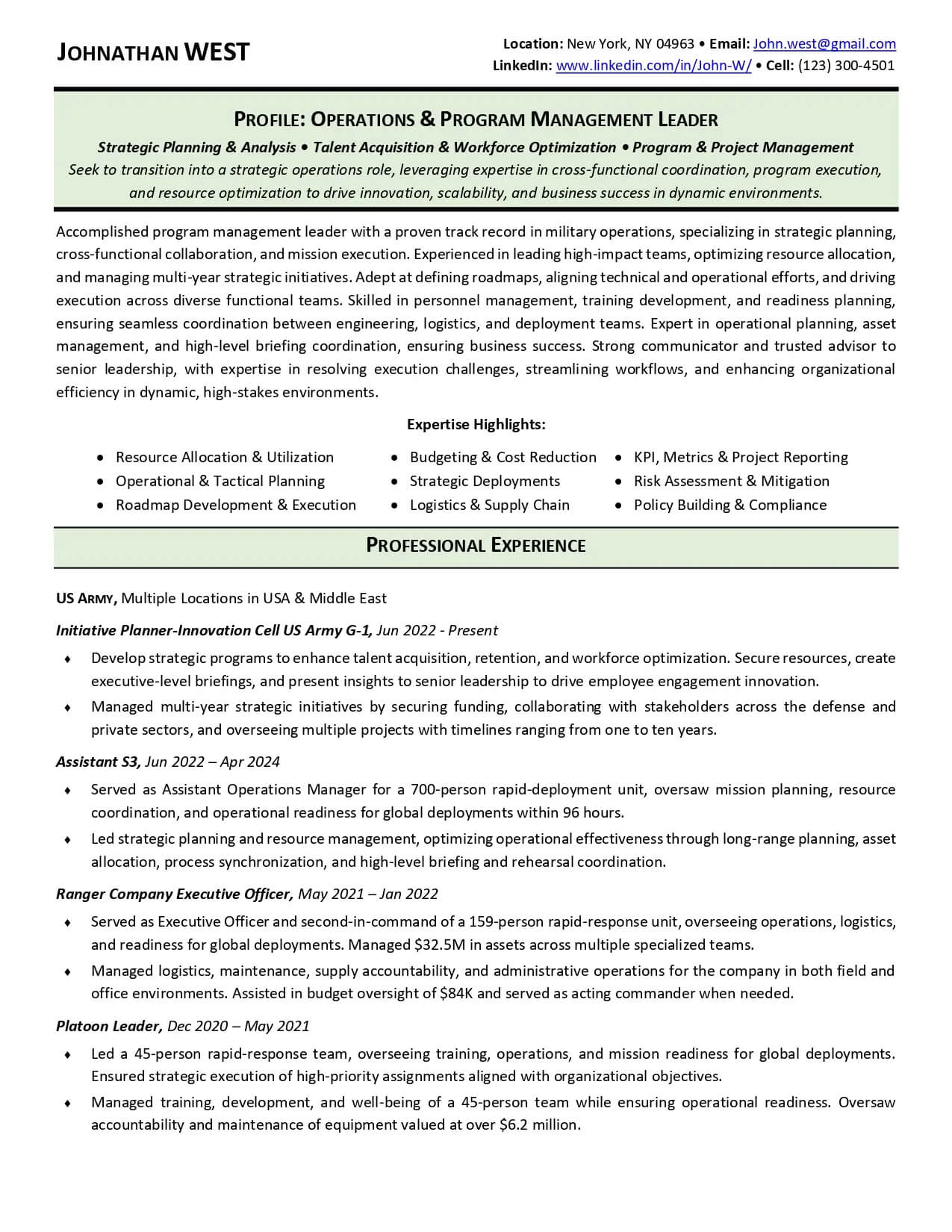
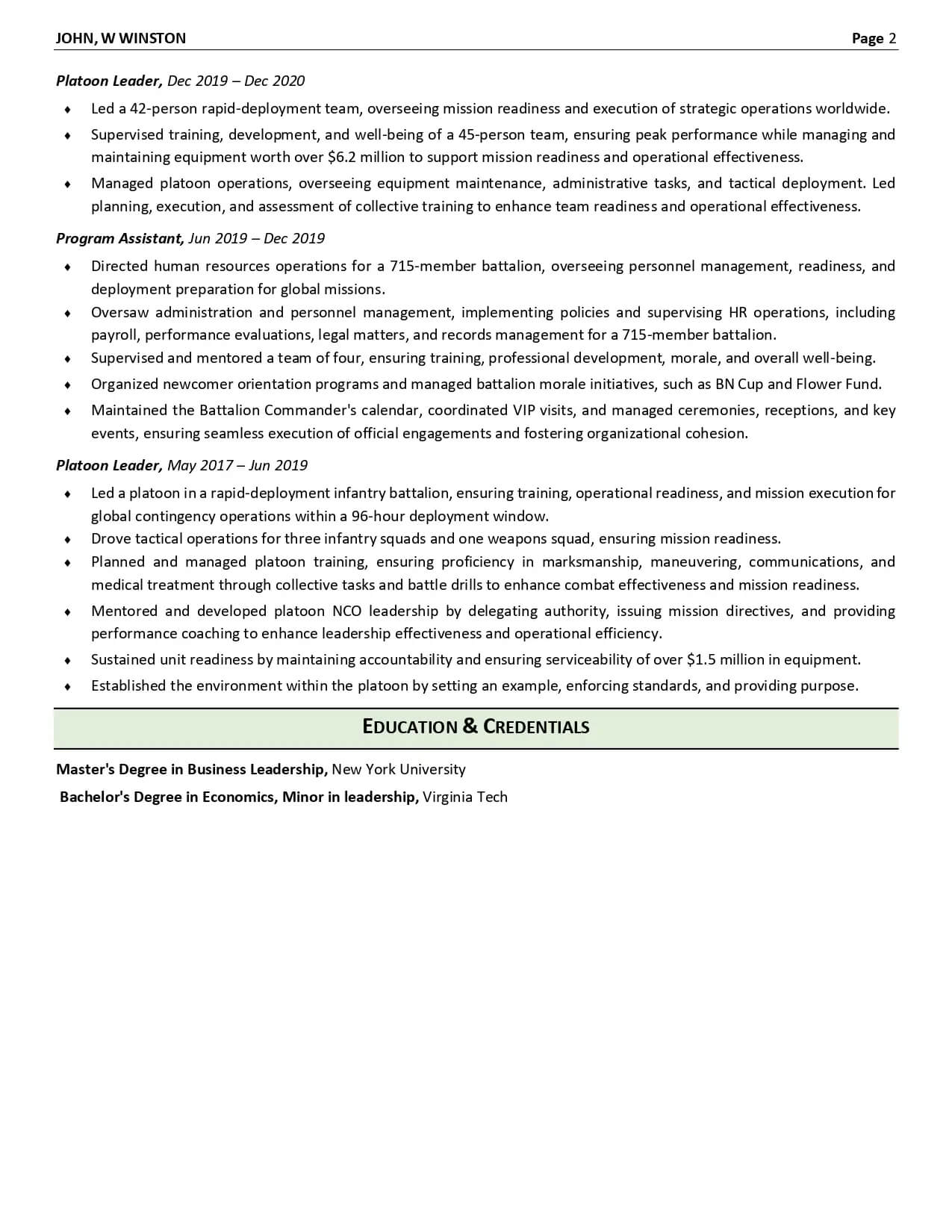
See it in action: Military to civilian resume sample
Sometimes the clearest way to understand how all of this comes together is to see a finished example. Below is a downloadable military-to-civilian resume sample that puts every principle from this article into practice — civilian-translated job titles, quantified bullet points, a strong professional summary, and a clean chronological structure that leaves no gaps unexplained. Study the formatting, the language choices, and the way military experience is framed as leadership and operational expertise rather than service-specific duty. Whether you're transitioning out after four years or twenty, this sample gives you a concrete starting point to build from.
Resources that can help & final thoughts
The transition process has real structural support available. A few worth knowing:
- American Job Centers — federally funded employment assistance, including resume workshops for veterans
- Hiring Our Heroes (U.S. Chamber of Commerce Foundation) — career transition programs and hiring fairs
- USAJOBS.gov — for federal employment, which has its own resume format requirements
- LinkedIn's Veterans Program — one year of LinkedIn Premium free for veterans, plus resume resources
- Transition Assistance Program (TAP) — a Department of Defense program that provides employment support during separation
If you're applying to federal positions specifically, be aware that federal resumes follow a different format than civilian resumes. That's a separate document with its own requirements.
* * *
The skills that made you effective in service are exactly what the civilian world needs and often struggles to find. The gap isn't in your qualifications. It's in translation. And translation is learnable and achievable.
If you'd like expert help making your military background shine in a way that opens civilian doors, Resumeble's professional resume writers specialize in exactly this kind of work. We've helped hundreds of veterans land roles that match the depth of their experience. We'd be honored to help you do the same.